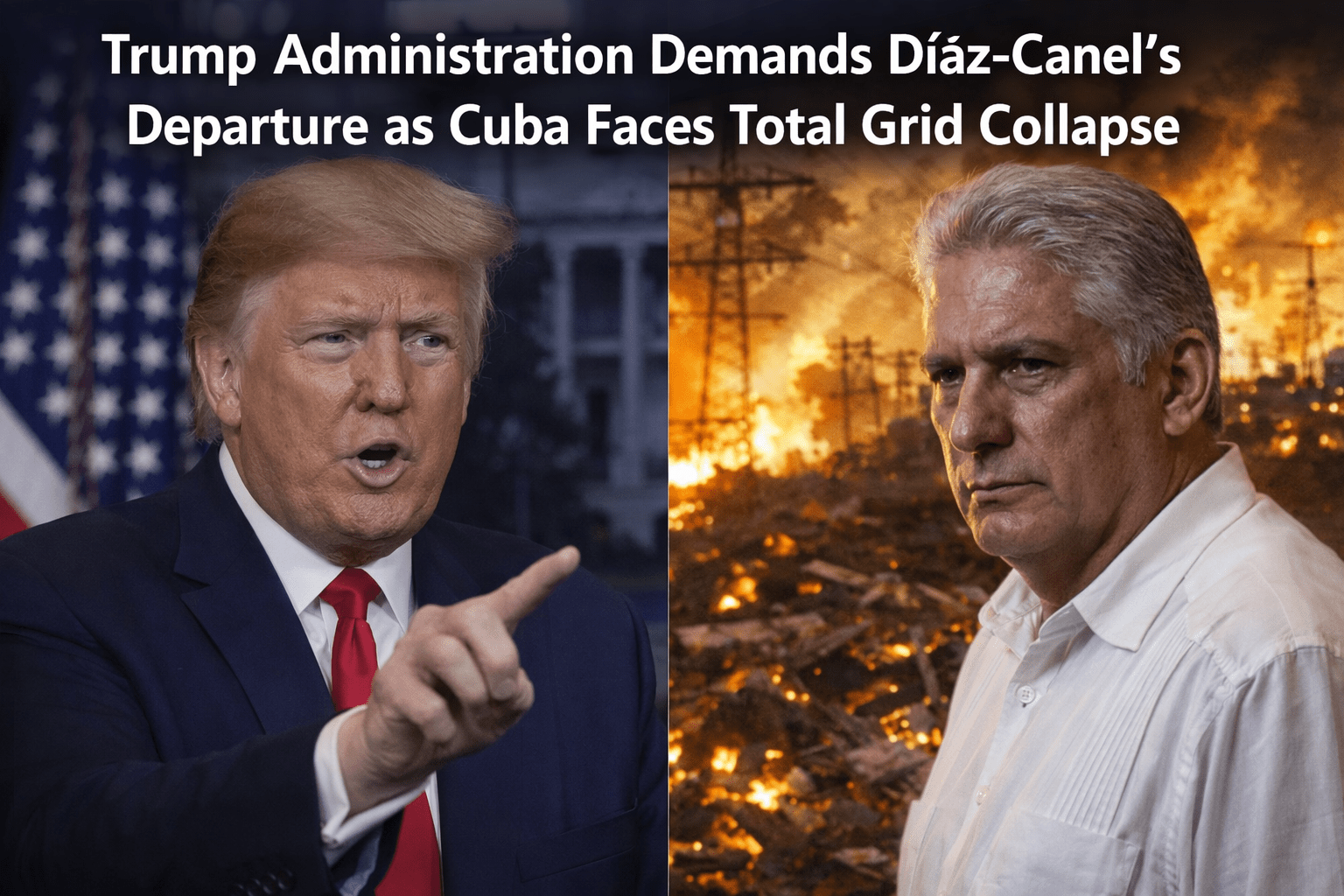
The U.S. has reportedly issued a direct ultimatum requiring Cuban President Miguel Díaz-Canel to resign as a precondition for normalising relations — while simultaneously leaving the door open for the Communist Party to remain in power. The demand arrives as Cuba endures its worst infrastructure crisis in decades.
Reporting drawn from New York Times sourcing on U.S.-Cuba negotiations, White House press briefing transcripts, and on-the-ground reporting from Havana · Updated March 2026
The Trump administration has delivered what sources familiar with the discussions described to the New York Times as a direct ultimatum to Cuban government interlocutors: President Miguel Díaz-Canel must step down as a prerequisite for any structural easing of U.S. economic pressure on the island. The demand — unusual in its specificity about a foreign head of state — is reportedly accompanied by a notable concession in the other direction: Washington is not, according to the same sources, demanding the dissolution of the Communist Party or an immediate transition to multiparty democracy. The U.S. position, as characterised by those sources, is that “the future of the country” should be left to the Cuban people once the current leadership obstacle is removed.
The combination — regime change at the presidential level without demanding systemic political transformation — reflects an approach that is difficult to characterise as either a conventional human rights posture or a straightforward geopolitical negotiation. It has drawn immediate criticism from Latin American governments and commentary from Cuba scholars who describe it as unlikely to produce either the political change or the domestic legitimacy that any post-Díaz-Canel transition would require.
Trump’s Remarks: Context and Diplomatic Implications
President Trump’s public comments at a White House press briefing added a layer of ambiguity that U.S. diplomats will face difficulty walking back in any formal negotiating context.
“Whether I liberate it or conquer it, I think I can do what I want with it. It’s a very weakened country,” Trump told reporters, adding that he believed he had “the honor of taking over Cuba.”
The remarks were not delivered in the context of a policy announcement or a diplomatic statement — they came in response to reporter questions during a briefing covering multiple topics. But in the context of active negotiations with the Cuban government, their effect on the diplomatic dynamic is not trivial. The phrase “conquer it” has no precedent in modern U.S. executive language about Cuba and will be used extensively by Cuban state media and allied governments to characterise the U.S. position as coercive rather than reformist.
The U.S. State Department has not issued a formal clarification of the remarks. Cuba’s Ministry of Foreign Affairs responded with a statement describing the comments as confirmation of what it characterised as longstanding U.S. imperial ambitions toward the island.
For regional context, the remarks arrive at a moment when the Community of Latin American and Caribbean States (CELAC) and several individual governments — including Mexico, Brazil, and Colombia — have been critical of what they describe as U.S. unilateralism in Cuban affairs. Trump’s framing will complicate any multilateral diplomatic effort to address Cuba’s humanitarian situation through coordinated pressure rather than bilateral ultimatum.
The Full List of U.S. Demands
Beyond the presidential resignation demand, sources describe a broader set of conditions the U.S. is presenting as requirements for either normalising bilateral relations or easing the economic pressure that has accelerated Cuba’s current crisis:
Leadership personnel changes. Beyond Díaz-Canel specifically, the U.S. is reportedly seeking the removal of senior officials identified as loyalists to the revolutionary model established under Fidel Castro — a demand that would require significant restructuring of the Cuban Communist Party’s upper tier, not merely a change at the presidential level.
Structural economic reform. The U.S. position, according to sources, frames Díaz-Canel personally as the obstacle to economic liberalisation that would attract foreign investment and reduce Cuba’s dependence on external patrons including Russia and Venezuela. The specific reforms being sought have not been publicly detailed by U.S. officials, but the framing echoes U.S. Treasury and OFAC communications from earlier periods of attempted engagement under the Obama administration, when private sector development and reduced state enterprise dominance were the primary benchmarks.
Release of political prisoners. The Cuban Commission for Human Rights and National Reconciliation (CCHDH), a Havana-based independent monitoring group, estimated earlier this year that Cuba holds over 1,000 political prisoners — many arrested following the historic July 11, 2021 protests that swept the island. The release of political detainees has been a standing condition of U.S. policy toward Cuba across administrations; its inclusion here is consistent with that history rather than a new demand.
The Infrastructure Crisis: What Is Actually Happening to Cuba’s Power Grid
The diplomatic pressure is unfolding against a humanitarian backdrop that is genuinely severe and has been building for several years.
Cuba’s national electricity grid experienced a total collapse — a complete loss of generation and distribution capacity across the entire island — in October 2024, and has experienced further partial collapses since. Daily power outages of 20 or more hours have become the norm in many parts of the country for the better part of eighteen months.
The crisis has three interlocking causes that cannot be addressed independently:
Fuel supply collapse. Cuba’s electricity generation is overwhelmingly dependent on thermoelectric plants running on fuel oil and diesel. Venezuela, which supplied heavily subsidised oil to Cuba for two decades under the terms of agreements negotiated by Hugo Chávez, has reduced supply sharply as its own production has declined. Russia, which stepped in partially as an alternative supplier, has faced its own constraints. The U.S. embargo, which restricts Cuba’s access to dollar-denominated international markets, limits Havana’s ability to purchase fuel at market rates from third-country suppliers even when it has the hard currency to do so — which increasingly it does not.
Physical infrastructure deterioration. The Cuban Electric Union (UNE), the state utility, has published technical reports acknowledging that a significant proportion of the island’s generating capacity is operating beyond its designed service life and requires replacement rather than repair. The capital investment required to address this — estimated by Cuban economists at multiple billions of dollars — has not been available under the economic conditions of the past decade. When the October 2024 collapse occurred, the proximate cause was the failure of the Antonio Guiteras thermoelectric plant, the island’s largest, which triggered a cascade failure across the interconnected grid.
Import constraints from the embargo. Replacement parts for both generating equipment and transmission infrastructure require access to international supply chains that U.S. sanctions complicate. While the embargo technically permits third-country sales of humanitarian goods, the secondary sanctions risk for non-U.S. companies doing business with Cuba has deterred many suppliers from engaging even on transactions that would be technically permissible.
The United Nations and Red Cross have both documented deteriorating humanitarian conditions, with food insecurity and healthcare system degradation linked directly to the energy crisis — hospitals without reliable power cannot maintain refrigeration for medications or operate surgical equipment consistently.
Social Unrest: The Protests in Morón
The incident in Morón, a city in Ciego de Ávila province in central Cuba, is the most publicly reported of a pattern of social unrest that has been documented across the island over the past several months. Protesters — accounts suggest predominantly neighbourhood residents rather than organised opposition groups — stormed a local government office to protest chronic food and energy shortages. A fire broke out in the building during the confrontation; Cuban state media attributed it to the protesters, while opposition sources contested that characterisation.
The Morón incident follows a pattern of localised protests that has been increasing in frequency since the July 11 protests of 2021 — the largest spontaneous civic demonstrations in Cuba since the 1994 Maleconazo — were suppressed with mass arrests. The Cuban government’s response to subsequent protests has combined security force deployment with limited local economic concessions, a pattern that has contained but not resolved the underlying social pressure.
Human Rights Watch and Amnesty International both maintain ongoing documentation of protest-related detentions in Cuba. Their 2025 reports describe a pattern of long pre-trial detention, restricted access to legal representation, and sentences that the organisations characterise as disproportionate to any legitimate public order justification.
Who Is Miguel Díaz-Canel?
Miguel Díaz-Canel, 65, assumed the Cuban presidency in April 2018, succeeding Raúl Castro — ending six decades of uninterrupted Castro family leadership of the Cuban state. He was confirmed as First Secretary of the Communist Party in 2021, consolidating both the governmental and party leadership roles that Raúl Castro had previously held separately.
Díaz-Canel’s political profile is that of a party technocrat rather than a revolutionary figure: he rose through provincial party structures in Villa Clara, served as Minister of Higher Education, and was elevated through a career defined by institutional loyalty rather than ideological distinctiveness. He has supported limited economic reforms — expanded self-employment categories, some private business legalisation — while maintaining the centralised state enterprise model that dominates the Cuban economy and resisting more fundamental structural changes.
His public approval, always difficult to measure in a country without independent polling, has declined measurably since 2021. The economic crisis has generated open public criticism that was rare under the Castros, including critical social media posts by Cuban citizens that have circulated widely despite government efforts to restrict internet access during protest periods. His administration has two years remaining in its current constitutional term.
Historical Context: U.S.-Cuba Policy Since the Thaw
The current confrontational posture reverses the limited diplomatic normalisation achieved under the Obama administration, which restored full diplomatic relations with Cuba in July 2015 after more than five decades of rupture, removed Cuba from the U.S. State Sponsors of Terrorism list, and eased some travel and remittance restrictions.
The first Trump administration reversed most of those measures: Cuba was returned to the terrorism list in January 2021, additional OFAC sanctions designations were imposed on Cuban entities and officials, and the Title III provisions of the Helms-Burton Act — which allow U.S. nationals to sue foreign companies for trafficking in expropriated Cuban property — were activated for the first time since the Act’s passage in 1996.
The Biden administration largely maintained the Trump-era sanctions architecture while removing Cuba from the terrorism list in a last-days-of-office action in January 2025 — a designation the current Trump administration promptly reinstated upon taking office.
The oscillation between engagement and pressure has, by most assessments, produced neither political liberalisation in Cuba nor improved humanitarian conditions for the Cuban population. The Brookings Institution and Council on Foreign Relations have both published analyses arguing that the embargo’s primary effect has been to provide the Cuban government with an external scapegoat for domestic failures while insulating it from the economic pressures that market integration would otherwise create.
What Comes Next: The Range of Outcomes
The scenario space from the current diplomatic moment is genuinely wide.
The most likely near-term outcome, based on the pattern of previous U.S.-Cuba confrontations, is a continuation of the status quo: the U.S. demands are not met, Cuba does not collapse, and the humanitarian crisis deepens incrementally while both governments use the standoff for domestic political purposes.
A negotiated leadership transition — in which Díaz-Canel steps down and is replaced by a figure acceptable to both the Communist Party’s internal power structure and the U.S. — would require a degree of Cuban government acquiescence to external pressure that has no historical precedent and would face significant legitimacy challenges domestically. The Cuban Communist Party has demonstrated over six decades that it prioritises institutional survival over individual leadership, but it has also demonstrated that it treats external demands for leadership change as existential threats to be resisted rather than pragmatic offers to be evaluated.
A humanitarian crisis severe enough to trigger genuine political instability — of the kind that would make current leadership untenable regardless of external pressure — remains a possibility given the depth of Cuba’s energy and food crisis, but the timeline and triggering conditions are impossible to predict with confidence.
What is clear is that the Trump administration’s public framing — particularly the “liberate or conquer” language — has narrowed the diplomatic space for the kind of quiet, face-saving negotiation that produced the 2015 normalisation. If a negotiated outcome is to be achieved, it will require either a significant shift in the public posture of one or both parties, or an intermediary with standing in both capitals willing to bridge the gap between what each side can say publicly and what each might accept privately.
Sources & Further Reading
- New York Times — U.S.-Cuba negotiations reporting
- U.S. State Department — Cuba country page and sanctions policy
- U.S. Treasury / OFAC — Cuba sanctions programme
- Human Rights Watch — Cuba World Report 2025
- Amnesty International — Cuba country profile
- Cuban Commission for Human Rights and National Reconciliation (CCHDH)
- Reuters — Cuba national grid collapse reporting, October 2024
- Council on Foreign Relations — U.S.-Cuba relations backgrounder
- Brookings Institution — Cuba policy analysis
- Helms-Burton Act Title III — State Department implementation
- UN — Cuba humanitarian situation reporting
- International Committee of the Red Cross — Cuba