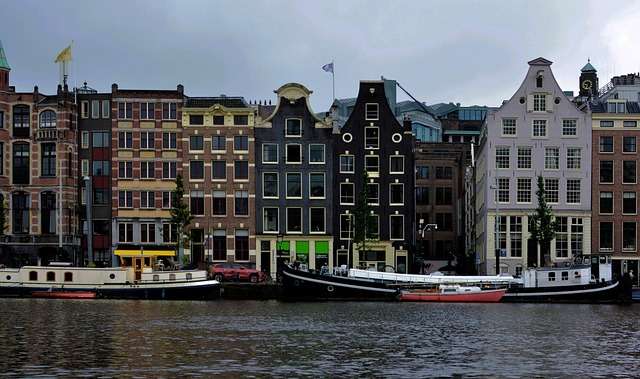
A Nation That Holds Its Debt Like a Weapon
There is a particular kind of fiscal pride that runs through Dutch public life — a pride that is not merely cultural but constitutional in character, embedded in the national accounting frameworks, the coalition agreements, and the sober quarterly projections of De Nederlandsche Bank. It is the pride of a country that has, for most of the past decade, treated balanced budgets the way other nations treat military alliances: as the foundational guarantee of national security. And for a long time, that instinct served the Netherlands extraordinarily well.
But 2026 is not a long time ago.
In the spring of this year, the Netherlands finds itself at the intersection of two economic realities that refuse to coexist comfortably. The first is a debt position the envy of almost every finance ministry in Europe: the government’s debt-to-GDP ratio stood at 43.7 percent in 2024 TRADING ECONOMICS — less than half the eurozone average and well inside the Maastricht ceiling of 60 percent. Public debt stood at 43 percent of GDP, the second-lowest level in 45 years, last lower only in 2007. De Nederlandsche Bank By the clinical standards of sovereign debt management, the Netherlands is in rude health.
The second reality is more complicated. The government deficit is forecast to widen to 2.7 percent of GDP in 2026, with public debt projected to reach 47.9 percent of GDP by the end of the year, rising further toward 48.1 percent in 2027. Economy and Finance That trajectory, modest as it sounds against the debt mountains of France or Italy, represents a deliberate political choice: to spend, and to spend substantially, on the premise that the returns will eventually outpace the borrowing costs. The question at the centre of Dutch fiscal policy in 2026 is not whether to accumulate debt. It is whether the investments financed by that debt will generate sufficient economic returns to justify its existence.
This is the paradox at the heart of the Dutch blueprint. A nation that built its post-war economic identity on fiscal conservatism is now, with careful and deliberate intention, treating public borrowing as a form of venture capital. And unlike the profligate spending experiments of southern European governments that haunted eurozone bond markets a decade ago, the Dutch version of this gambit is prosecuted from a position of genuine strength. The Netherlands is not borrowing because it must. It is borrowing because its economists, its central bank, and a growing political consensus have concluded that in the macroeconomic conditions of 2026, simply hoarding fiscal space delivers worse outcomes than deploying it.
The thesis underpinning this piece is straightforward, though its implications are not: in an economy constrained not by capital but by productive capacity, debt reduction through austerity is a category error. What reduces debt-to-GDP sustainably is not the numerator shrinking — it is the denominator growing. Return on investment, not fiscal restraint, is the operative variable. The Netherlands, almost uniquely among its European peers, has the balance sheet and the institutional credibility to test this proposition at scale.
It is doing so against a backdrop of structural pressures that make passive fiscal management essentially impossible. According to the most recent figures from Statistics Netherlands, there were 97 job openings for every 100 unemployed people at the end of 2025 — well above the long-term pre-pandemic average of 32 vacancies per 100 unemployed. De Nederlandsche Bank The Dutch labour market has not merely tightened; it has reached a condition that economists call near-full employment and that business owners simply call crisis. The Netherlands has reached near-full employment, making staff shortages a structural problem for the years ahead. New Stardom Healthcare, construction, ICT, and education are all reporting vacancy rates that are not cyclical fluctuations but permanent features of the landscape. Labour shortages remain the biggest constraint for businesses, and demographic pressures mean the population aged 20 to 65 will become stagnant from 2027 onwards and start declining in 2029, limiting the number of working people. ABN AMRO
Into this tight labour market, the government is being asked to simultaneously fund an ambitious green transition. The Dutch energy transition is a national priority, underpinned by government commitments to reduce carbon emissions by 55 percent by 2030. International Trade Administration That target carries a price tag that cannot be met through private investment alone. The PBL Netherlands Environmental Assessment Agency has warned that there are fewer and fewer policy options that would realise a 55 percent emission reduction by 2030 without generating serious economic damage or societal resistance. Pbl The green transition, in other words, is not merely a climate imperative — it is a fiscal and structural stress test arriving simultaneously with the labour crunch.
What makes the Dutch case genuinely instructive for the rest of Europe — and indeed for any advanced economy grappling with the post-pandemic fiscal settlement — is that The Hague is not attempting to solve these problems sequentially. It is betting that the right kind of public investment addresses all three simultaneously: it creates the productive capacity that grows GDP, the infrastructure that reduces energy costs, and the automation that compensates for the missing workers. Whether that bet is well-calibrated, or whether it represents the hubris of a creditor nation that has confused its balance sheet strength with immunity from economic gravity, is the question this article sets out to answer.
The Ghost of Groningen and the Architecture of What Comes Next
For sixty years, the Dutch state ran a quiet and extraordinarily lucrative extractive operation beneath the fields of its most seismically passive province. The Groningen gas field, discovered in 1959 and developed with meticulous financial engineering between Shell, ExxonMobil, and the Dutch government, was for two generations the silent underwriter of the Netherlands’ enviable public finances. Between the start of production in the 1960s and its eventual closure, the Dutch treasury received approximately €363 billion from the field — a figure that dwarfs almost any comparable natural resource windfall in western European history. Statista At its peak in 1982, Groningen gas revenues accounted for nearly a fifth of total government receipts. The Dutch welfare state, the infrastructure, the universities — all were built, in part, on the quiet exhalation of ancient organic matter two kilometres underground.
The earthquakes changed everything. An unprecedentedly strong seismic event measuring 3.6 on the Richter scale in Huizinge in 2012 accelerated the public debate about extraction’s impact CEIC Data, and the political consensus unravelled rapidly thereafter. By October 2023, Groningen gas production was down to zero, marking a historical moment for the Netherlands as it navigated the transition from fossil fuel exporter to importer. World Economics The country that had once set the benchmark price for European gas — the TTF hub remains the continent’s dominant natural gas trading venue, a structural legacy of Groningen’s dominance — had become a net energy importer almost overnight. The closure hit productivity measurably: Statistics Netherlands found that productivity had slowed faster than in most industrialised countries over the past decade, with the decline of the minerals sector reducing overall productivity by 0.3 percent between 2013 and 2019. Statistics Netherlands
The fiscal arithmetic of this transition is stark and, for a government that once relied on hydrocarbon rents to smooth its public accounts, deeply uncomfortable. The question facing The Hague is not whether it can replicate Groningen’s revenue contribution — it cannot, not directly — but whether a deliberately constructed clean energy infrastructure can eventually generate the kind of stable, long-term transit income that makes a comparable fiscal contribution. The answer, embedded in the investment programme now being prosecuted across the Dutch North Sea, is that it is being designed to do exactly that. The vehicle is wind. The product is hydrogen. And the strategic logic is not merely environmental — it is mercantilist.
The scale of the offshore wind ambition is, even by European standards, formidable. As of December 2025, the Netherlands operates 13 offshore wind farms totalling roughly 4.7 GW of capacity, all bottom-fixed projects in the North Sea. De Nederlandsche Bank That figure, while significant, is merely the preface. The Netherlands intends to reach 21 GW of offshore wind capacity by 2030/2031 New Stardom, a fourfold increase within five years that would place roughly 75 percent of current national electricity consumption on renewable generation. In 2026, the government has earmarked €948.3 million from the Climate Fund to tender 2 GW of new offshore wind capacity with subsidies ING THINK, even as the wind sector grapples with rising construction costs and supply chain bottlenecks. The revised North Sea Wind Energy Infrastructure Plan of July 2025 acknowledges that the transition from fossil fuels to electricity by industry is lagging and that offshore wind construction costs have risen ING Think, forcing a recalibration of the 2040 target — though the direction of travel remains unchanged.
The financial model that transforms this wind buildout from a costly public good into a revenue-generating asset rests on a single conversion technology: electrolysis. When surplus offshore wind electricity — power generated at times when grid demand is insufficient to absorb it — is directed through an electrolyser, it splits water molecules into hydrogen and oxygen. The hydrogen can be stored, piped, shipped, or used as an industrial feedstock. The Dutch government has explicitly planned for some of the country’s offshore wind capacity to be used for large-scale green hydrogen production in the North Sea, with energy hubs at sea enabling connections with other North Sea countries. PwC This is not a speculative future scenario. It is permitted, tendered, and in active construction.
Shell’s Holland Hydrogen I facility at Rotterdam’s Maasvlakte is the most visible expression of this strategy. With an electrolyser capacity of 200 MW, it is expected to produce approximately 21,900 tonnes of green hydrogen annually, powered by the Hollandse Kust Noord offshore wind farm and connected via pipeline to Shell’s refinery at Pernis. U.S. Department of State It is the largest green hydrogen plant in Europe, and it sits at the mouth of a distribution network being assembled with the deliberate intent to make the Netherlands the continental clearing house for clean hydrogen — precisely the role it played for decades with natural gas.
The infrastructure logic is compelling because it leverages what the Netherlands already has: Gasunie, one of Europe’s most sophisticated gas transmission operators; the Port of Rotterdam, the continent’s largest industrial port; and thousands of kilometres of existing pipeline corridors that can be repurposed rather than rebuilt. Gasunie’s Hynetwork subsidiary is rolling out the national hydrogen network in phases, with the first section in Rotterdam operational by 2026 at the latest, followed by connections to industrial clusters along the Dutch North Sea coast before 2030, and cross-border links to Germany and Belgium thereafter. International Trade Administration The capital cost of this national network has escalated sharply: a 2025 investment estimate put the cost at €3.8 billion — more than double the €1.5 billion projected in 2023, partly because Hynetwork will not be able to reuse as much existing pipeline as previously assumed. European Commission
That cost overrun is real, and it deserves acknowledgment. But it does not undermine the strategic logic; it merely illustrates that the transition from fossil infrastructure to clean infrastructure is being executed at engineering complexity that planners initially underestimated. The more significant question is what the network, once built, will earn. Hydrogen is now physically flowing through Rotterdam’s first major 32-kilometre pipeline segment, making it the first major section of the Dutch hydrogen network to be charged with RFNBO-certified hydrogen. Pbl The Delta Rhine Corridor, the cross-border pipeline initiative linking Rotterdam to major industrial demand centres in Germany and beyond, is projected for completion between 2031 and 2033. A proposed cross-border hydrogen pipeline linking Germany and the Netherlands cleared a critical technical hurdle in late 2025, though as 2026 begins, the project remains constrained by regulatory sequencing and the absence of finalised construction timelines. Donor Tracker
The transit fees and throughput revenues that will eventually flow through this network — from imported hydrogen arriving by ship from North Africa, Australia, and Brazil; from domestically produced green hydrogen moving to German industrial buyers; from ammonia cracked back into hydrogen at Rotterdam’s terminals — represent the closest fiscal analogue to what Groningen provided. They are not extraction rents from a depleting resource. They are permanent infrastructure tolls on a permanent energy flow. The wider network will link to import terminals at seaports, domestic hydrogen production sites, and large-scale storage facilities, including salt caverns in the country’s north European Parliament — repurposed, in a sense, from the same geological formations that once stored natural gas. The Dutch are not rebuilding what they lost. They are constructing something structurally similar but indefinitely renewable, and they are using public debt to finance the bridging period before those revenues materialise.
Whether the timeline holds — whether the electrolyser capacity, the cross-border connections, and the international supply chains arrive on schedule — is where the investment thesis carries its greatest risk. Groningen was a geological given. The hydrogen hub must be built, negotiated, regulated, and certified into existence. The confidence of Dutch policymakers that it can be rests on one asset that is not at risk of earthquake or geopolitical disruption: geography. The Netherlands sits at the point where the North Sea, the Rhine corridor, and the European industrial heartland converge. That was true when the first gas pipeline was laid in 1963. It remains true today.
When the Law Becomes a Balance Sheet Problem
In the spring of 2019, a Dutch administrative court delivered a ruling that managed something few legal decisions ever accomplish: it simultaneously became an environmental landmark and an economic catastrophe. The Council of State’s verdict that the government’s nitrogen management framework violated EU Habitats Directive law did not merely change permit procedures or recalibrate emissions targets. It froze the country. The ruling led to the immediate suspension of approximately 18,000 construction projects Eurostat — housing developments, motorway expansions, data centres, energy infrastructure — all halted at a stroke because the legal basis on which their environmental permits had been issued no longer existed. This effectively froze all building permit applications, creating economic paralysis: farmers unable to expand their operations, large technology companies unable to construct data centres, the government unable to build new highways, and ordinary citizens unable to build new homes. World Economics
The scale of the resulting economic damage is staggering and, crucially, still accumulating. According to ABN AMRO, the initial permit freeze put some €14 billion worth of projects in immediate jeopardy. IMF More recent assessments have revised that figure substantially upward: economic disruption to businesses — encompassing delayed road construction, stalled housing projects, and deferred investments — is projected to reach €30 billion in lost revenue between 2024 and 2030. Economy and Finance This is not a correction. It is not a market adjustment or a temporary supply disruption. It is a structural lock on the productive capacity of an advanced economy, imposed by an invisible ceiling — the maximum nitrogen deposition that EU-protected nature zones can absorb — that sits lower than the Netherlands’ existing economic activity.
To understand why this matters so acutely to the Dutch fiscal blueprint, the underlying chemistry must be briefly confronted. The Netherlands is not merely a nitrogen-intensive economy by accident. It is, by deliberate historical design, one of the most agriculturally productive countries on earth relative to its land area — the world’s second largest food exporter by value, a title it holds with extraordinary efficiency but at enormous ecological cost. The Netherlands has the densest livestock population in Europe, and some 80 percent of ammonia emissions — the primary airborne nitrogen compound — originate from animal manure. IMF This agricultural intensity is not easily unwound. Successive governments promised reform and delivered compromises. In 2008, the Dutch Council of State ruled that developers had to demonstrate their projects would not harm nature; in response, the government issued permits on the assumption that future emissions reductions would compensate — an assumption that proved to be legally untenable a decade later. TRADING ECONOMICS The consequences of that prolonged evasion now sit on the national balance sheet as a debt of a different kind: labour market tightness, electricity grid congestion, housing shortages, and the nitrogen crisis together constitute the most significant cluster of structural constraints on Dutch competitiveness identified in the OECD’s 2025 Economic Survey. Wikipedia
The housing dimension of this constraint deserves particular focus, because it is where the fiscal logic of the nitrogen unlock is most clearly legible. Market analyses indicate that in 2025, there was a deficit of approximately 395,000 homes — the highest in over a decade — and the gap continues to widen as new construction fails to meet growing demand. FiscalNote House prices were, on average, 8.5 percent higher in 2025 than in 2024. Columbia University Efforts to increase housing supply are simultaneously held back by persistent labour shortages, slow permitting procedures, restrictions on construction activities due to the obligation to reduce nitrogen depositions, and growing bottlenecks in connecting new housing to the electricity grid — all pushing up construction costs and delaying the completion of new dwellings. GECF The compound effect of all three constraints operating simultaneously is a housing market in which the government’s stated target of one million new homes by 2030 is being missed not by a rounding error but by a structural margin. Despite anticipated growth, the Netherlands is unlikely to meet its goal of constructing 100,000 homes annually, and the construction industry itself warns it will require 94,000 new employees in the next five years just to avoid serious delays. FiscalNote
Every home that is not built is a unit of property tax revenue, transfer tax income, and VAT on construction that never reaches the Dutch treasury. Every data centre that cannot receive a permit is a corporation that relocates to Germany or Ireland, taking its payroll taxes, employer contributions, and supply chain spending with it. The nitrogen crisis is not, therefore, merely an environmental and agricultural challenge. It is an active drag on the denominator of the debt-to-GDP equation — a mechanical suppressor of the economic growth on which the entire investment thesis of the Dutch blueprint depends. Resolving it is not optional. It is arithmetically necessary.
The solution that is emerging — tentatively, expensively, but with growing technical credibility — operates on two simultaneous fronts: attacking the source of nitrogen emissions through advanced manure processing technology, and redesigning the construction process itself so that it generates negligible on-site emissions in the first place.
The most technically ambitious intervention at the agricultural source is plasma-based manure processing, a technology that sounds like science fiction but is demonstrably operational on Dutch farms. Norway’s N2 Applied, operating out of its Wageningen base in the heart of Dutch agricultural country, has developed a plasma-powered system that allows farmers to produce sustainable fertilizer from manure using only air and electricity. The technology works by stripping electrons from atmospheric atoms — creating plasma — and using the resulting reactive nitrogen species to chemically bind the ammonia in liquid manure slurry, transforming it from a volatile emission source into a stable, high-value fertilizer. De Nederlandsche Bank The agricultural proposition is compelling on its own terms: a 25-kilowatt plasma unit can process the manure or biogas digestate from between 100 and 200 dairy cows per year, and through the control unit, data is collected that allows farmers to report their emissions to regulatory authorities. New Stardom That last detail — automatic emissions reporting — is not a minor administrative convenience. It is the mechanism by which plasma-processed farms can demonstrate compliance with nitrogen permit conditions that would otherwise be impossible to meet, unlocking the permits that unlock expansion.
Beyond the farm gate, a parallel innovation is dissolving the nitrogen lock on construction itself. The logic is elegant and, in retrospect, obvious: the reason construction sites emit nitrogen is that diesel-powered equipment operates for months or years on location. Remove the equipment from the location — manufacture the building components in a factory and deliver them as finished modules for rapid assembly — and the on-site emissions footprint collapses. Research led by TNO, the Netherlands Organisation for Applied Scientific Research, has demonstrated that industrialised prefabricated construction in a factory not only builds faster, but automatically reduces nitrogen emissions on site — and the Ministry of the Interior has committed to a follow-up programme running from 2024 to 2026 to drive adoption. Chambers and Partners Once the modules reach a construction site, a complete building can be erected within a few weeks rather than the many months of traditional construction, meaning significantly less inconvenience, less construction traffic, and critically, far lower emissions per completed dwelling. Germanwatch e.V
The economic implications of the modular approach extend well beyond the immediate nitrogen relief. Dutch firms now lead Europe in prefabricated construction digitalisation, with robotics being actively tested in façade and structural assembly — and the prefabricated construction sector is projected to expand from its 2024 value of €3.67 billion to approximately €5.14 billion by the end of 2029. Donor Tracker From accounting for just 10 percent of new residential builds four or five years ago, prefab housing had reached a 21 percent market share by 2024, with expectations of achieving 50 percent of new residential construction by 2030. European Commission What began as a regulatory workaround to nitrogen emission limits is now positioned to become an export industry in its own right — the Netherlands commercialising the systematic knowledge of how to build at scale, quickly, cleanly, and with a fraction of the skilled on-site labour that conventional construction demands.
This is the structural logic that gives the nitrogen pillar its place in the debt-reduction framework. The €30 billion in suppressed economic activity sitting behind the nitrogen lock is not lost value — it is deferred value, waiting for the permit system to reopen. When a combination of plasma manure processing and modular zero-emission construction sufficiently lowers ambient nitrogen deposition to allow permits to flow again, that suppressed value begins releasing into the tax base. New homes generate property taxes, stamp duties, and VAT. New data centres generate corporate tax receipts and payroll contributions. New roads and energy infrastructure allow other investments to proceed. The nitrogen crisis, viewed through the lens of the Dutch fiscal blueprint, is not a cost to be managed — it is a revenue stream waiting to be unlocked.
The Port as a Processing Engine: Revenue at Machine Speed
There is a moment, somewhere in the early hours of any given morning, when the Port of Rotterdam is operating at a scale that resists easy comprehension. Handling more than 470 million tonnes of cargo annually, it is Europe’s largest and most digitally advanced port — a testing ground for automated logistics, artificial intelligence, real-time data exchange, and autonomous vessels, where every crane, terminal, and container movement forms part of a connected digital ecosystem. IMF But the raw tonnage figure, as imposing as it is, understates Rotterdam’s actual economic significance. An Erasmus University study, commissioned by the Port Authority, found that €45.6 billion — or 6.2 percent of the Netherlands’ total added value — flows through or because of the port. European Commission That calculation, crucially, includes not just the direct activity of loading and unloading, but the vast archipelago of distribution, logistics, manufacturing, and financial services that Rotterdam’s throughput makes possible throughout the Dutch economy. The port is not infrastructure in the conventional sense. It is a transaction engine, and the Dutch state collects a fee on every transaction that flows through it.
Understanding this framing is essential to understanding why the investment in making that engine faster, smarter, and more impenetrable to fraud occupies a central position in the Dutch fiscal blueprint. A port that processes more cargo in the same physical space generates more port dues, more customs revenue, more employment, and more corporate tax receipts — all without requiring a single square metre of additional land reclamation. Rotterdam’s container capacity has more than tripled over the last thirty years, and that growth has been driven largely by the adoption of technology and the improvement of productivity De Nederlandsche Bank, as Albert Veenstra, professor of trade and logistics at Erasmus University, has noted. The digital layer being constructed on top of the physical port is not a supplement to that productivity story. It is its next chapter.
The centrepiece of that digital layer is the port’s digital twin — a live, virtual replica of the entire port complex, fed by continuous data streams from thousands of sensors embedded across its 42-kilometre operational footprint. The initiative, led by the Port Authority, creates a virtual replica powered by GIS and IoT, enabling real-time monitoring, simulation, and management of port operations — addressing the complexity of handling 140,000 vessels annually while optimising operations to accommodate crewless ships by 2030. Economy and Finance The data inputs are exhaustive: weather conditions, tidal streams, water salinity, wind speeds, berth availability, and the physical characteristics of every approaching vessel are combined in real time to determine optimal berthing windows, cargo sequencing, and traffic management. Eurostat What this produces, in operational terms, is the capacity to eliminate the wasted time that is the primary economic enemy of port throughput. A ship waiting at anchor is not generating port dues, not employing stevedores, and not contributing to the VAT chain that extends from Rotterdam’s quays to distribution centres across the European hinterland. Every hour shaved from a vessel’s port call is recoverable economic value.
Digital twin deployment in 2025 demonstrated a 20 percent throughput increase in comparable port environments ING THINK, a figure that, applied to Rotterdam’s existing container volumes, translates into millions of additional TEU-equivalent movements without a single new berth being constructed. Rotterdam’s director of innovation, Oscar van Veen, has been explicit about the underlying philosophy: “For us, it is not about getting the people out but getting the data in.” Exactpi The autonomous guided vehicles and remote-controlled cranes that now operate across the Maasvlakte terminals are not, in this framing, primarily a labour-cost reduction strategy — though they deliver that too. They are data-generating nodes in a self-optimising system that becomes more efficient with every additional cycle of operation.
The 5G private network infrastructure underpinning this system represents an architectural choice that carries long-term consequences the port’s planners have been quite deliberate about. The Port Authority installed sensors across its entire 42-kilometre area and deployed a private LTE network architecture to build a digital twin capable of mirroring, tracking, and pre-piloting all shipping movements, infrastructure conditions, weather patterns, and water depth readings in real time. Statista Smart ports integrating IoT sensor networks, 5G connectivity, and digital twin infrastructure reduce turnaround times, lower emissions, and improve safety through predictive analytics and automated equipment DutchNews.nl — but the more commercially significant outcome is the data itself. Rotterdam is not merely building a smarter port. It is building a proprietary intelligence platform about European trade flows, vessel behaviour, and logistics patterns that has commercial value well beyond the port’s own gates.
The fiscal capture mechanism at the front of this system — the point at which the Dutch state converts that intelligence into revenue — is undergoing its own transformation, one that is less visible than autonomous cranes but arguably more consequential for the public balance sheet. Customs fraud and container misrepresentation represent a chronic and structurally underreported source of import duty leakage in every major port. Rotterdam has been addressing this with an interlocking architecture of digital verification tools that make fraudulent declaration progressively harder to execute.
The Secure Chain system, operated through Portbase — the neutral logistics platform for Dutch ports — eliminates PIN codes for container release, replacing them with a closed digital chain in which the shipping line, shipper, forwarder, and carrier each digitally authenticate the right to collect a specific container. Only a haulier or barge operator authorised through the full chain can access the terminal. Pbl The system’s adoption rate is now effectively total among deep-sea services: all major deepsea shipping lines — including CMA CGM, COSCO, Evergreen, Hapag-Lloyd, Maersk, and MSC — and all deepsea terminals in Rotterdam have adopted the platform, with coverage expanding through 2024 to encompass cargo from Latin America, North America, Africa, the Middle East, India, and Pakistan. Pbl The five-hundred-thousandth import container processed through the system passed through Rotterdam’s gates in September 2024 — a milestone that marks not a celebration of volume but a confirmation of institutional reach. By digitally notifying carriers of customs check registrations in real time, the system has eliminated cases where containers sat for entire weekends awaiting manual notification — turnaround times compressed from days to minutes. International Trade Administration
The broader customs digitisation programme, developed in partnership between the Port of Rotterdam Authority, Dutch Customs, and Portbase, addresses a more structurally significant problem: the use of fraudulent container access codes — historically obtained through criminal infiltration of logistics chains — to intercept drug shipments, reroute cargo, or misrepresent the contents of containers for duty purposes. The Port Community System enables efficient coordination and information exchange across the entire Rotterdam logistics chain, helping prevent data fraud and making it harder to illegally collect containers. International Trade Administration The financial dimension of this is not trivial. The Netherlands processes roughly 30 percent of all EU container imports; incremental improvements in the accuracy of customs declarations across that volume translate into measurable improvements in import duty receipts that flow directly to the Dutch treasury and the EU budget.
What emerges from the convergence of autonomous terminal operations, digital twin intelligence, and blockchain-secured customs processes is something that the Port of Rotterdam’s own strategic documentation describes with quiet precision: the transition of the Port Authority from physical infrastructure manager to what it calls a “port entrepreneur” — a supplier of data services as well as berth space. The port’s digital infrastructure enables objects to communicate independently: quay walls interacting with ships, containers coordinating with cranes, terminals synchronising with trains and trucks, all exchanging information without human intervention to optimise available capacity. PwC In financial terms, this transition is already visible in the numbers: the Port Authority reported revenue of €940.4 million in 2025, up 6.6 percent, with EBITDA of €583.6 million Gas Outlook — a margin structure that would be envied in most infrastructure businesses, generated from a port that is simultaneously investing heavily in its own obsolescence and replacement.
The risk to this pillar, as the 2025 annual figures make clear, is not technological but geopolitical. Several chemical companies announced plans to close their Rotterdam factories, and investments in new and ongoing sustainability projects were halted Columbia University — a consequence of European industry’s deteriorating competitive position against cheaper Asian and American production. If the industrial hinterland that Rotterdam serves declines in output, the transaction volume flowing through the port contracts regardless of how efficiently the port itself operates. No algorithm resolves a demand shock. The digital twin optimises what flows through the port; it cannot conjure flows that are not there. That vulnerability — the dependence of the logistics revenue thesis on the continued vitality of European industrial production — is the fault line running beneath Pillar 3, and it is one that Dutch policymakers have not yet adequately answered.
The Trillion-Euro Pivot: When a Pension System Becomes a Sovereign Investment Vehicle
There is a peculiar irony in the fact that the most consequential financial event in the Netherlands in 2026 is not a government bond issuance, a tax reform, or a central bank intervention. It is the quiet, administratively complex, legally laborious transfer of retirement savings from one legal structure to another — a process so technically arcane that most of the 9.5 million workers it directly affects could not describe it in a single coherent sentence. And yet, in its fiscal implications for the Dutch state, the pension overhaul enacted under the Future Pensions Act — the Wet toekomst pensioenen, or Wtp — may matter more than any other domestic policy decision of the decade.
The scale of what is moving requires a moment of deliberate comprehension. Dutch pension funds collectively hold more than €1.5 trillion in assets, and the shift to the new defined contribution system is reshaping allocations at a scale felt across international financial markets. Statistics Netherlands To place that figure in context: it is roughly equal to twice the Netherlands’ annual GDP, and it represents the largest pool of institutionally managed capital in continental Europe relative to the size of the economy that generated it. For decades, the management of this extraordinary stockpile was governed by a defined-benefit framework that created one overriding investment imperative: match long-duration liabilities with long-duration assets. Dutch pension funds became, as a result, structural buyers of 30- and 50-year sovereign bonds and long-dated interest rate swaps — not because those instruments offered the best risk-adjusted returns, but because they were the mechanical requirement of a liability-hedging system. Under the old system, around 71 percent of all pension liabilities were hedged, creating one of the most duration-intensive institutional investment profiles in the world. TRADING ECONOMICS
The Wtp dismantles this architecture entirely. As of 1 January 2026, a large number of pension funds switched to the new system, bringing approximately 9.5 million workers under defined-contribution rules where pension accrual takes place through individual investment accounts and the final benefit depends on economic developments and investment results rather than a guaranteed promise. IMF Around €550 billion in assets transferred to the new system in January 2026, marking the beginning of a process that will eventually encompass some €900 billion in total by 2027. Economy and Finance The individual funds are recalibrating their portfolios in consequence: younger participants, freed from the liability-matching straitjacket, are being allocated into equities and growth assets; older participants are retaining some duration hedging but at dramatically reduced scale. The net effect, as PIMCO and ING have both identified, is a structural withdrawal of one of the largest price-insensitive buyers of long-dated European fixed income from the market — an event whose significance for sovereign borrowing costs across the eurozone is still being absorbed.
For the Dutch state itself, the fiscal implications of this reallocation are more nuanced — and more strategically interesting — than the headline bond-market analysis suggests. The critical question is not where the pension money was, but where it is going. When €1.5 trillion in assets transitions from a framework optimised for liability-matching to a framework optimised for long-term returns, it generates a wave of reallocation demand for productive assets: infrastructure, private equity, green energy projects, and domestic real assets. The Dutch government has been deliberate in ensuring that the new DC investment framework encourages domestic infrastructure investment — which means, in practical terms, that a portion of the capital being released from long-dated bond portfolios may find its way back into the very green hydrogen networks, modular housing programmes, and digital infrastructure projects that constitute the Dutch investment blueprint. The pension system is not merely being reformed as a social policy. It is being repositioned, with careful design, as a sovereign wealth channel — mobilising private capital for national strategic ends without requiring it to appear on the government’s own balance sheet.
A significant feature of the transition is a one-time pension boost delivered at the end of 2025 and beginning of 2026, compensating workers in their forties and fifties who contributed under the old redistributive system. World Economics That one-time boost, paid directly into individual pension pots rather than as cash, injects a further pulse of investable capital into the system precisely at the moment when the new DC framework is establishing its initial asset allocation. The liquidity event is real, it is large, and it is, by design, being directed toward productive rather than extractive investment.
Then there is defence — a sector that the Netherlands has historically treated as a necessary cost, a geopolitical obligation discharged at minimum viable scale. That posture ended at the NATO Summit in The Hague in June 2025. The Dutch government agreed to raise its defence budget to 3.5 percent of GDP — described by acting defence minister Ruben Brekelmans as a historic decision — with an additional 1.5 percent of GDP to be spent on broader security-related investments including cybersecurity and infrastructure improvements. New Stardom The Netherlands has pledged to spend at least 3.5 percent of GDP on defence until 2035, with the aim of reaching an extra €19 billion in annual spending by that date. De Nederlandsche Bank Read as a security commitment, this is already a profound break with Dutch fiscal tradition. Read as industrial policy — which is the framing that Dutch economic planners have been quietly but insistently applying — it is something more architecturally significant: the largest deliberate expansion of the domestic high-technology manufacturing base in a generation, financed entirely by the defence budget.
The numbers make this argument concrete. Dutch defence expenditure is set to rise from €22 billion in 2025 to around €38 billion by 2030, with cumulative spending between 2025 and 2030 amounting to approximately €178 billion — of which PwC estimates around €41 billion could flow directly to the Dutch manufacturing sector. Exactpi That €41 billion is not abstract procurement. It is orders for Thales Netherlands radar systems, frigates from Damen Naval, submarine components from IHC, and — critically — a vast expansion of the tier-two and tier-three supplier network that feeds these original equipment manufacturers. An increasing amount of previously underutilised industrial capacity is now being converted to defence applications, with VDL’s former Nedcar automobile factory among the facilities being repurposed, while drone manufacturing — a sector in which the Netherlands had already established civilian expertise — is emerging as a fast-growing dual-use branch as companies adapt existing civilian applications to military requirements. Chambers and Partners
The concept of “dual-use” is doing significant analytical work in this context, and it deserves precision. In trade law, dual-use describes goods and technologies with both civilian and military applications — the category that governs ASML’s export control obligations and the licensing regime that The Hague has been progressively tightening since 2023. In the industrial policy context being described here, the concept works in reverse: civilian high-technology capability becomes the feedstock for defence production, and defence procurement contracts become the guaranteed revenue stream that finances R&D with civilian applications. This is precisely the model that created the American aerospace-defence-semiconductor complex over the post-war decades, and it is the model that the Dutch government is now deploying with clear-eyed intentionality.
The Dutch semiconductor ecosystem already constitutes a nearly complete value chain — world-leading lithography through ASML, front-end deposition through ASM International, advanced packaging through BESI, and large fabless portfolios through NXP and Nexperia — concentrated in the Brainport Eindhoven cluster and supported by targeted public investment to relieve constraints in housing, mobility, energy, and skills. Windows That ecosystem did not emerge from defence contracts. But its skills, its precision engineering capabilities, its photonics expertise, and its systems integration capacity are precisely the inputs that modern defence electronics — radar, guidance systems, drone control, electronic warfare — require. PwC’s analysis identified more than three thousand Dutch production companies that could play a role in meeting the defence scaling need, with particularly strong potential among tier-n suppliers whose high-tech capabilities in semiconductor and medical technology translate directly into valuable defence sub-systems. Exactpi
The De Nederlandsche Bank’s own February 2026 analysis of defence spending’s economic consequences adds a further dimension that conventional fiscal accounting tends to miss. Research shows that anticipated defence spending generates forward-looking demand effects: firms anticipate tighter future labour markets and increase hiring immediately, while investment rises as businesses adjust capacity in response to higher expected demand — with total factor productivity increasing and remaining positive for several years as firms make fuller use of existing capacity. DutchNews.nl This is the productivity dividend of anticipated public investment — the economy begins reorganising itself around the expected demand before the spending actually arrives. For a labour-constrained economy like the Netherlands, the timing matters enormously: ABN AMRO estimates that in an upside scenario where defence spending climbs to 3.5 percent of GDP, growth could rise by 0.4 percentage points in 2026 alone. ABN AMRO
What the pension reform and the defence expansion share — beyond their individual significance — is a structural characteristic that distinguishes both from conventional government stimulus: neither requires the Dutch treasury to borrow directly from foreign creditors in order to deploy capital at scale. The pension transition mobilises private savings accumulated over decades. The defence expansion activates industrial capacity that already exists, paying for it with NATO-justified expenditure that carries its own political legitimacy. Together, they represent a form of financial leverage that does not appear as sovereign debt on any balance sheet — a multiplication of the Dutch investment blueprint’s reach that is all the more powerful for being invisible to the deficit calculators in Brussels.
Where the Blueprint Meets Its Limits
Every investment thesis has a stress test. For the Dutch blueprint, there are three — not hypothetical scenarios drawn from academic modelling, but live, operational constraints actively throttling the economy in 2026. They are not equivalent in character: the first is a physical problem, the second is a social one, and the third is a mathematical one. But they share a common feature that makes each of them dangerous: left unresolved, any one of them is sufficient to unravel the logic of the entire programme.
The Grid: When Ambition Outpaces Infrastructure
The deepest irony of the Dutch green investment thesis is that the infrastructure designed to power it is incapable of carrying the load that the ambition creates. Grid congestion has become a pressing and defining problem, with operators such as Liander and TenneT warning businesses of wait times of up to ten years for new connections or expansions. TRADING ECONOMICS A country that has staked its fiscal future on offshore wind, hydrogen electrolysis, data-centre-driven logistics intelligence, and the electrification of an entire industrial base is simultaneously rationing the electricity that all of those things require. The bottleneck is not ambition. It is copper, transformers, and substations.
The scale of the backlog is now a matter of public emergency rather than regulatory inconvenience. The shortage of grid capacity is holding back economic growth, with the pressure on the network described by government ministers as no longer a challenge but a real problem. Eurostat According to the SME Monitor, 90 percent of Dutch businesses are experiencing direct or indirect consequences of grid congestion De Nederlandsche Bank — a figure so broad that it effectively describes the entire productive economy. With more than 11,900 businesses currently awaiting electricity network connections, an estimated €200 billion in investment through 2040 will be needed to provide the required grid capacity. Economy and Finance That investment horizon — fourteen years — is the most uncomfortable number in the entire Dutch energy transition. The offshore wind buildout will be substantially complete by 2031. The hydrogen network is designed to be operational before 2030. But the grid that must carry the electrons those assets generate will not be fully expanded until well after both.
TenneT’s own projections indicate that the provincial electricity grid in North Holland will become overloaded as early as winter 2026-27 if no additional action is taken, with the Vijfhuizen subgrid — heavily loaded by data centres — already facing an imminent first overload. CEIC Data The national response has been characterised by bureaucratic effort and physical insufficiency in roughly equal measure. From 2020 to 2024, the Netherlands installed over 100,000 kilometres of underground cables and 2,419 transformers in 2024 alone — yet despite this massive investment, medium-voltage connection rollouts fell by 25 percent in the same year, reflecting the degree to which congestion is outpacing remediation. De Nederlandsche Bank The government has launched more than 100 targeted actions through its National Grid Congestion Action Programme, introduced time-of-use tariffs for large industrial users, and is deploying the GOPACS platform to enable flexible capacity deployment across distribution system operators. These are the right interventions. They are arriving too slowly.
De Nederlandsche Bank’s own modelling is explicit on the consequence: a scenario in which the government successfully addresses the grid alongside nitrogen and other structural bottlenecks would generate GDP growth approximately 0.4 percentage points higher per year on average than the baseline projection. Germanwatch e.V That gap — 0.4 points annually, compounding across a decade — is not a rounding error. It is the difference between a debt-to-GDP ratio that stabilises and one that drifts. The grid is not merely a technical problem. It is a fiscal variable.
The Human Factor: The Gap Between Disruption and Dignity
The second bottleneck is less visible in government reports and more visible in the lived experience of the workers whose jobs are being redesigned, accelerated, or eliminated by the same technological investment that the Dutch blueprint celebrates. The Netherlands leads Europe in AI adoption, with 95 percent of organisations running AI programmes De Nederlandsche Bank — a statistic that, delivered in the context of a labour market already tight to the point of structural crisis, creates a tension that the investment thesis has not adequately confronted. The Dutch blueprint needs more workers to execute its ambitions. It is simultaneously deploying technology that is reorganising the nature of work faster than the workforce can absorb.
The World Economic Forum’s Future of Jobs Report projects that approximately 22 percent of current jobs in the Netherlands will be affected by digitalisation and AI between 2025 and 2030, with 39 percent of current workforce skills estimated to become outdated over the same period. ING Think These are not abstract statistical constructs. They describe, in aggregate, millions of individual transitions — from existing roles to retraining programmes, from familiar competencies to unfamiliar ones — that must be navigated without a social contract adequate to their scale. Some 86 percent of Dutch companies are accelerating process and task automation specifically because they cannot find sufficient workers through conventional hiring ING Think, which creates the perverse situation where AI deployment is both a response to labour shortage and a generator of labour displacement — simultaneously. The workers most vulnerable to displacement are, characteristically, those with the least capacity to absorb it: junior vacancies in customer service and IT have already slid measurably year-on-year, with entry-level positions registering the earliest and most acute pressure as routine query-handling is automated. New Stardom
The political economy of this transition is where the fiscal blueprint is most exposed. A government that is borrowing to invest in automation and AI-driven logistics faces a legitimacy problem if the productivity gains from that investment accrue primarily to capital, while the displacement costs land on labour. The Netherlands has, historically, managed this tension better than most — its social partnership model, its relatively generous unemployment and retraining provisions, and the political weight of the FNV trade union federation have produced more equitable technological transitions than comparable economies achieved. But the pace of AI adoption in 2025 and 2026 is qualitatively different from the automation waves the Dutch social model was designed to absorb. Labour economists like Anna Salomons of Utrecht University caution that a quick crash course on AI is wholly insufficient to equip workers for the pace of change, calling instead for multi-layered training programmes, on-the-job learning, and practical scenario-based mentoring — especially for workers unfamiliar with digital tools. De Nederlandsche Bank The gap between what is currently being provided and what is required is substantial. EY’s AI Barometer 2025 found that 61 percent of Dutch respondents expect AI to affect their work, 42 percent fear job loss, and only 24 percent are satisfied with their employer’s AI training provision. OECD A workforce that is anxious about its economic future and unsatisfied with the support it is receiving is a workforce that votes — and the political capital required to sustain the Dutch investment blueprint across multiple electoral cycles is not unlimited.
The Interest Rate Trap: When r Chases g
The third bottleneck is the one that economists return to when the optimism of the other two fades: the differential between the interest rate on government debt (r) and the growth rate of the economy (g). This is, at its simplest, the arithmetic of debt sustainability. When g exceeds r, a government can run a primary deficit and still watch its debt-to-GDP ratio decline, because the denominator is growing faster than the interest accumulation on the numerator. When r exceeds g, the mathematics reverse, and debt dynamics become self-reinforcing in the wrong direction. The entire Dutch blueprint is, implicitly, a bet that g stays above r.
The current data deserves honest scrutiny. Dutch benchmark ten-year yields averaged 2.8 percent over the first eight months of 2025, near their highest levels since 2010-11, reflecting tighter global funding conditions. European Commission Against that borrowing cost, GDP growth is forecast at 1.3 percent in 2026 before recovering to 1.7 percent in 2027 Donor Tracker — a trajectory that places the growth rate uncomfortably close to, or below, the cost of sovereign borrowing for an extended period. The margin of safety, while not yet alarming given the Netherlands’ extraordinary starting position, is narrower than the investment thesis implicitly assumes.
The OECD’s 2025 Economic Survey is direct in its concern: according to the CPB’s medium-term forecast, the growth in government expenditure is expected to increasingly outpace the growth in revenue under current policy settings, with the fiscal balance deteriorating steadily until 2033 — particularly from 2029 onwards, beyond the current government’s term. Chambers and Partners The Dutch government’s own Draft Budgetary Plan acknowledges that if policy remains unchanged, the deficit and debt are likely to rise above the European reference values in the medium term, making continued commitment from future cabinets an explicit precondition for the plan’s sustainability. International Trade Administration That last phrase carries the full weight of its political implication: the Dutch blueprint is, ultimately, a multi-decade programme that requires a decade of consecutive political consensus to deliver. The OECD warns further that the fiscal expansion risks exacerbating inflationary pressures in an already tight labour market, and that the ECB’s eurozone-wide monetary stance may be insufficiently tight to contain price pressures specific to the Dutch economy. U.S. Department of State
Scope Ratings, which affirms the Netherlands at AAA, projects the debt-to-GDP ratio reaching 49.6 percent by 2030 European Commission — still well within Maastricht limits and entirely manageable by any conventional sovereign credit metric. But the direction of travel — from 43.7 percent in 2024 to nearly 50 percent within six years — is a trajectory that narrows the fiscal headroom available to absorb shocks. A global recession, a collapse in European industrial production, a geopolitical disruption to the North Sea energy infrastructure, or a hydrogen demand market that fails to materialise at the scale required would each push that trajectory higher, faster. The Netherlands is not approaching a crisis. But it is consuming the buffer that protected it from one — and it is doing so on the explicit assumption that the investments it is making will replenish that buffer before it is exhausted. That assumption is not unreasonable. It is, however, an assumption. And the distance between an assumption and a guarantee is where fiscal crises are born.
The Nation That Chose to Build Its Way Forward
History will likely record 2026 as the year the Netherlands made a decision that most advanced economies have spent decades avoiding: it chose to define itself not by what it owed, but by what it was building. The distinction sounds like semantics. In fiscal policy, it is everything.
For two centuries, the Dutch economic identity was legible and consistent. The Netherlands was a trading nation — a geographic intermediary, a clearing house for continental commerce, a country that added value by moving things rather than making them, and that accumulated wealth through the compounding logic of entrepôt geography. The country’s trade-driven prosperity was built on strong institutions, advanced infrastructure, and a highly skilled workforce Economy and Finance, and those foundations remain intact. But the conditions that made the trading-nation model so durable — stable global supply chains, cheap fossil energy flowing through Groningen, open international trade architecture, a protected position within an integrating European market — are all, simultaneously, under structural revision. The model is not broken. It is being made progressively less sufficient as the world reorganises around it.
What is replacing it — the architecture being assembled through the four pillars examined in this article — is something qualitatively different: a tech-infrastructure nation. By 2030, projections for the Dutch tech ecosystem suggest it could generate 250,000 new jobs and add €400 billion in economic value CEIC Data, figures that, if realised even partially, would represent the largest structural shift in Dutch economic composition since the discovery of Groningen gas. The semiconductor complex around Brainport Eindhoven, the hydrogen transit infrastructure at Rotterdam, the modular construction and plasma manure-processing industries born from the nitrogen crisis, the AI-driven port intelligence platform, and the dual-use defence manufacturing base collectively describe an economy whose comparative advantage is migrating from location to knowledge — from being optimally placed on a map to being optimally equipped with technology, infrastructure, and institutional capacity.
The Netherlands already has a clear National Technology Strategy guiding priorities in digital innovation, covering semiconductors, AI, quantum, and cybersecurity World Economics — the four technology domains in which the combination of existing Dutch industrial capability and foreseeable structural demand is strongest. The country ranks second in the world for online connectivity, third in the WEF Global Competitiveness Index for technological readiness, and hosts one of Europe’s most important data centre clusters in Amsterdam Eurostat — a digital infrastructure position built over a decade of deliberate investment that is now a genuine competitive moat. These are not aspirations on a government strategy document. They are operational realities whose expansion the current investment programme is designed to accelerate.
The Port of Rotterdam alone envisions supplying 4.6 megatons of hydrogen to Europe annually by 2030, of which the vast majority — 4 megatons — would be transit trade rather than domestic production Economy and Finance, embedding the Netherlands as the indispensable clearing-house for European clean energy in precisely the way it was once indispensable for natural gas. The fiscal logic is identical: infrastructure that other economies depend on generates recurring revenue regardless of the commodity flowing through it. Groningen was a commodity. Hydrogen is a commodity. The pipeline is the durable asset, and the Netherlands is, by deliberate design, positioning itself to own the pipe.
The CPB’s own projections show the government deficit reaching 2.5 percent of GDP by 2030 Statistics Netherlands — still below the Maastricht ceiling, still manageable, still well inside the territory that triggers market concern. The IMF’s Article IV mission confirmed that deficits and debt are projected to remain structurally below 3 and 60 percent of GDP through 2030, with the fiscal position described as strong De Nederlandsche Bank, even as it cautioned against the medium-term trajectory beyond that horizon. These assessments, taken together, define the operating window of the Dutch blueprint: a decade of deliberate, investment-financed deficit expansion, prosecuted from a position of exceptional fiscal strength, designed to produce a structural uplift in GDP growth that resets the debt-to-GDP trajectory before the Maastricht ceiling comes into view.
Whether it works depends on three temporal sequences that must each arrive on schedule and in the correct order. The hydrogen network must be constructed and operational before the European industrial demand for clean hydrogen reaches the scale required to make transit revenues meaningful — and the OECD’s own analysis cautions that recent setbacks in hydrogen infrastructure in neighbouring countries and continued price disadvantage against carbon-intensive alternatives are creating investment hesitation that could delay that sequence. The nitrogen unlock must release sufficient construction and industrial activity to generate the tax revenues required to offset the public investment being made in plasma and modular construction technology — and that requires the permit system to flow at a pace that regulatory and judicial processes have historically not delivered. And the defence-industrial expansion must translate into productivity-enhancing civilian spillovers quickly enough to compensate for the labour-market inflation that a €38 billion annual spending commitment will inevitably generate.
None of these sequences is guaranteed. All of them are plausible. And the Netherlands, in committing to this programme, is implicitly accepting that the margin between plausible and guaranteed is the price of ambition — the irreducible uncertainty embedded in every investment, sovereign or otherwise.
Which brings us, finally, to the thesis with which this article opened and which the preceding six sections have been constructed to examine: that in 2026, saving does not pay down debt. Return on investment does. The claim is not novel — economists from Keynes to Olivier Blanchard have made versions of it across different fiscal contexts. But the Dutch execution of it is distinctive, because it is being prosecuted not from desperation, as so much Keynesian spending has been historically, but from confidence. The Netherlands does not need to borrow. It is choosing to borrow, for defined purposes, at a moment when its institutional credibility makes the borrowing cheap and its strategic position makes the investments available. That combination — the freedom to invest, rather than the compulsion to spend — is rarer in sovereign finance than it appears, and it is what distinguishes the Dutch blueprint from the stimulus programmes it superficially resembles.
The OECD’s central recommendation to the Dutch government — to reallocate spending towards productivity-enhancing investments while containing long-term spending pressures — is, in essence, an endorsement of the blueprint’s core logic IMF, even as it urges the fiscal discipline that keeps the programme from becoming its own undoing. The international institutional community is not telling the Netherlands it is wrong to invest. It is telling it to invest wisely, consistently, and with a political commitment that outlasts electoral cycles.
That last requirement — political durability — may ultimately prove more demanding than any of the engineering, financial, or regulatory challenges the programme faces. Coalition governments in the Netherlands have a historical tendency to recalibrate at each new formation, unwinding the long-term commitments of their predecessors in the service of short-term coalition arithmetic. The hydrogen network, the nitrogen technology, the defence-industrial complex, the pension reallocation infrastructure — none of these deliver their fiscal returns within a single parliamentary term. They require the kind of patient, compounding commitment that democratic systems find structurally difficult to sustain.
The Dutch are betting, in the end, on something more fundamental than the economics of any individual pillar. They are betting that their institutions are robust enough, their technocratic capacity deep enough, and their public trust resilient enough to hold a complex, multi-decade investment programme together across the political discontinuities that will inevitably punctuate it. That is a bet about national character as much as it is about macroeconomics. And if there is one country in Europe with the institutional track record to make it credibly — the country that built its entire civilisation on the collective decision to hold back the sea — it is this one.
Debt is not the enemy. Unproductive debt is. The Netherlands has decided to find out, at scale and with rigour, whether that distinction is as consequential as its architects believe. By 2030, the evidence will be too substantial to ignore in either direction. The world’s finance ministers will be watching.