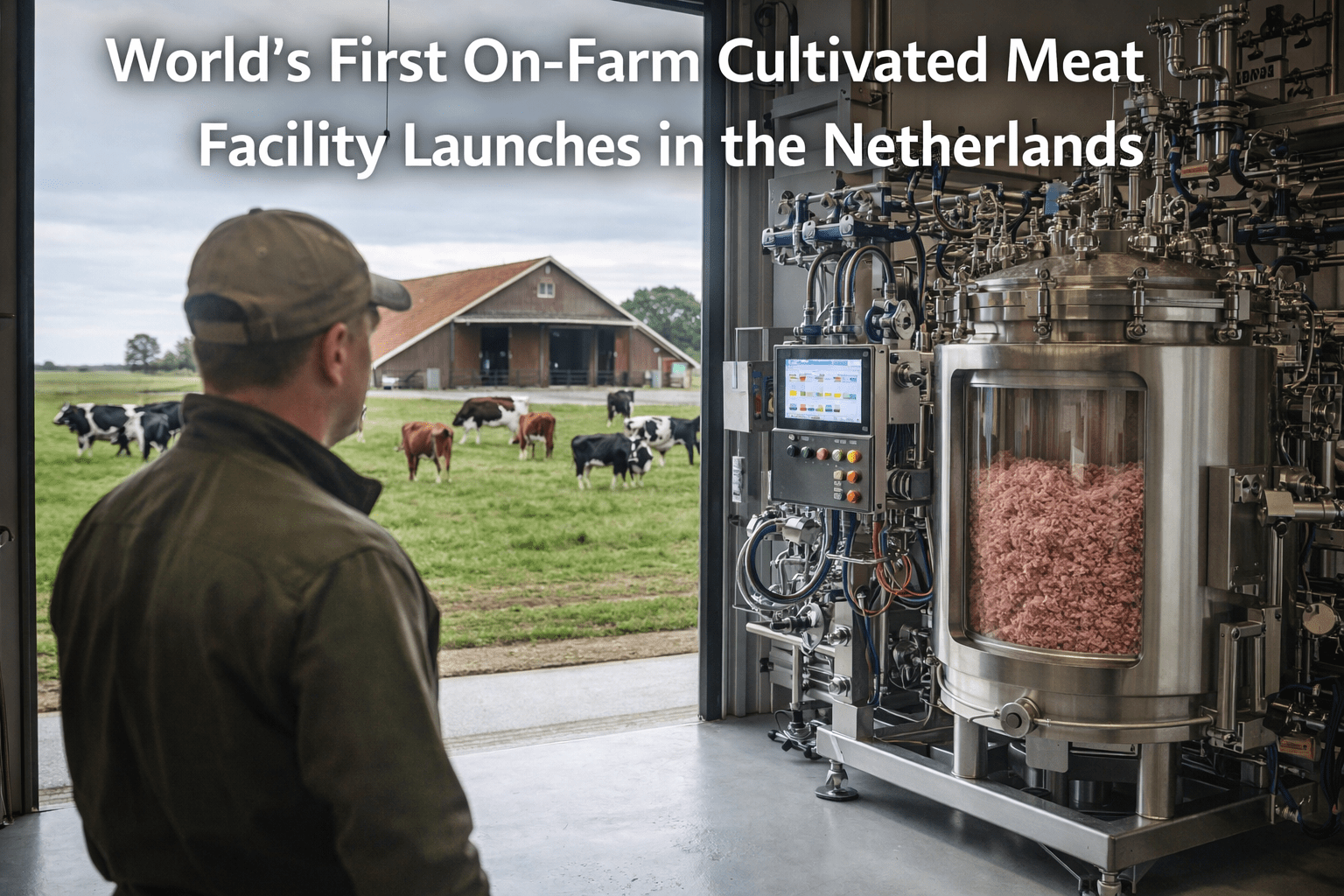
A dairy farm in Midden-Delfland, South Holland, has become the site of the world’s first on-farm cultivated meat production test unit — a collaboration between Dutch start-up RespectFarms and dairy farmer Corné van Leeuwen. The project challenges the assumption that lab-grown meat and traditional farming are in opposition, proposing instead a model where farmers operate the production infrastructure.
Reporting based on RespectFarms official communications, European Food Safety Authority novel food documentation, and cultivated meat market research from the Good Food Institute Europe · Updated March 2026
The cultivated meat industry has, since its public emergence with the first lab-grown burger demonstration in 2013, been predominantly framed as an urban, high-tech, factory-based replacement for conventional animal agriculture. Large bioreactor facilities, centralised production, and eventual retail distribution through existing food supply chains — this has been the dominant commercial vision pursued by companies including Upside Foods, Eat Just, and Mosa Meat, the Maastricht University spin-out founded by the scientist behind the 2013 demonstration.
The project launched at Corné van Leeuwen’s dairy farm in Midden-Delfland proposes a fundamentally different model — one in which the production unit is farm-scale, farmer-operated, and positioned as a complementary revenue stream rather than a replacement for the livestock operations already on site. Whether this model can work economically and at scale is an open question that the Midden-Delfland facility is specifically designed to test. But it represents the first concrete implementation of an approach that researchers and agricultural economists have proposed theoretically for several years.
What Is Actually Installed and How It Works
The production unit at Van Leeuwen’s farm centres on a bioreactor approximately the size of a large domestic appliance — small enough to be housed within an existing farm building rather than requiring dedicated industrial infrastructure. The bioreactor provides the controlled environment in which animal cells, sourced from a tissue biopsy of a living animal, are fed a nutrient growth medium and multiply to produce muscle tissue — the biological equivalent of meat — without requiring the animal to be slaughtered.
The core biology of cultivated meat production involves several stages that RespectFarms has adapted for farm-scale implementation:
Cell sourcing. A small tissue sample is taken from a donor animal — in this case, from cattle on or near Van Leeuwen’s dairy farm. The sample yields a population of muscle stem cells (satellite cells) capable of proliferation and differentiation into mature muscle tissue. The donor animal is unharmed by the biopsy procedure, and a single sample can theoretically yield enough cells to initiate a very large number of production runs through banking and expansion.
Proliferation. The harvested cells are introduced to the bioreactor, where they are maintained at appropriate temperature and supplied with a growth medium containing the amino acids, glucose, vitamins, and growth factors they require to divide and multiply. The composition of this growth medium is one of the most actively contested technical challenges in the industry: early formulations used foetal bovine serum (FBS), an animal-derived product whose use conflicts with the ethical positioning of cultivated meat. RespectFarms, in line with the current direction of the field, states it is working with serum-free and animal-component-free media formulations, though the cost and scalability of these alternatives at commercial volumes remains an active area of research.
Differentiation and harvest. Once sufficient cell mass is achieved, conditions are adjusted to trigger differentiation from proliferating stem cells into mature muscle fibres. The resulting tissue is harvested from the bioreactor and processed into a product with the nutritional profile of conventional meat.
The farm-scale unit at Midden-Delfland is not intended for commercial production — current EU regulatory status would not permit it — but for demonstrating that this process can be operated reliably and cost-effectively outside a dedicated laboratory or industrial facility by people with farming rather than biotechnology backgrounds.
The RespectFarms Model: Why Farmer-Centric Matters
The conventional cultivated meat industry model raises a specific concern for agricultural communities that RespectFarms is explicitly trying to address: the possibility that a successful transition to cellular agriculture would displace livestock farmers from food production entirely, concentrating the protein supply chain in large urban manufacturing facilities owned by technology companies rather than agricultural families.
This concern is not hypothetical. The economic logic of large-scale centralised bioreactor production — where capital costs are amortised over very high volumes and production can be located near distribution centres rather than near farmland — does point toward a structure that would make traditional livestock farming economically unviable in the same way that industrial food processing has made small-scale grain milling unviable.
Ira van Eelen, co-founder of RespectFarms and daughter of Willem van Eelen — the Dutch researcher widely regarded as one of the founding figures of cultivated meat science, who filed some of the first patents in the field in the 1990s — has framed the company’s mission explicitly around this concern. Her position, stated in public communications and in the launch materials for the Midden-Delfland facility, is that the protein transition should preserve farmers’ central role in food production rather than replacing them with technology companies operating at industrial remove from the land.
The practical model RespectFarms is testing is essentially a franchise or equipment-as-a-service structure: the company provides the bioreactor unit, the cell lines, the growth medium supply chain, and the technical protocols; the farmer provides the space, the animal proximity (relevant for cell sourcing), and the operational management. If the economics work — if the margin per unit of cultivated meat produced on a farm-scale bioreactor is sufficient to justify the capital and operating costs — the model could theoretically be replicated across existing livestock farms, distributing production capacity rather than concentrating it.
Corné van Leeuwen’s farm is a credible test site for this proposition. He already operates a modernised dairy farm with milk robots and runs a craft cheesemaking operation — a profile that reflects both openness to technological investment and a track record of identifying diversification opportunities before they become mainstream. “As a farmer, you have to look ahead,” Van Leeuwen said at the project launch. “This is an opportunity to see if a new revenue model fits what we already do. Not trying it would be a missed opportunity.”
The Regulatory Barrier: EU Novel Food Status
The most significant near-term constraint on the Midden-Delfland project — and on the European cultivated meat industry more broadly — is not technological but regulatory. In the European Union, cultivated meat is classified as a novel food under Regulation (EU) 2015/2283, which requires pre-market authorisation before any novel food can be sold to consumers. The authorisation process involves a safety assessment by the European Food Safety Authority (EFSA) followed by a European Commission decision.
No cultivated meat product has yet received novel food authorisation in the EU. As of March 2026, the regulatory status in the Netherlands — and across the EU — permits only scientific research and, under specific conditions, marketing-focused tastings that do not constitute commercial sale. The facility at Midden-Delfland operates within these permissions: it is a research and demonstration installation, not a commercial production site.
The EFSA novel food assessment process is rigorous and time-consuming by design. Applicants must submit comprehensive data on compositional analysis, nutritional profile, production process safety, allergenicity, and toxicology. The assessment timeline from submission to opinion has historically been two to three years for novel food applications, though EFSA has been working to streamline the process for cellular agriculture applications specifically. The Good Food Institute Europe, the Brussels-based non-profit that advocates for the alternative protein sector, has been engaged with EFSA and the European Commission on the regulatory pathway for cultivated meat since 2019 and publishes detailed tracking of the regulatory landscape.
The global regulatory picture outside the EU is more advanced. Singapore approved Eat Just’s cultivated chicken product in December 2020 — the world’s first regulatory approval for cultivated meat sale — and has since approved additional products. The United States granted GRAS (Generally Recognized as Safe) determinations to Upside Foods and Eat Just in 2023, with USDA inspection approval following shortly after. Israel has an active regulatory pathway and has approved commercial sale of specific products. The EU’s position — no approved product, no imminent approval timeline — represents the most significant regulatory gap relative to leading markets.
The Economics: What Needs to Be True for This Model to Work
The farm-scale cultivated meat model faces economic challenges that are distinct from but related to those of the industry as a whole. The fundamental challenge for all cultivated meat producers is the cost of the growth medium — the nutrient solution that feeds cell proliferation in the bioreactor.
Current estimates of growth medium cost vary widely depending on formulation and sourcing, but the Good Food Institute’s techno-economic analysis of cultivated meat production consistently identifies growth medium as the largest single cost component, accounting for 55–95% of direct production cost depending on the production process. At current costs, cultivated meat is not economically competitive with conventional meat at consumer price points. The industry thesis is that cost reductions will come through three routes: optimisation of growth medium formulations to reduce the concentration of expensive growth factors required, economies of scale in growth factor and amino acid production as volumes increase, and engineering improvements in bioreactor efficiency.
The farm-scale model introduces additional economic considerations. A small bioreactor has higher capital cost per unit of production capacity than a large industrial bioreactor — this is a basic principle of process engineering scale economics that no organisational model can circumvent. The farm-scale approach is therefore viable only if it can offer offsetting advantages: lower logistics and distribution costs (production near consumption), higher consumer willingness to pay for provenance-identified products (cultivated meat from a specific named farm), or the ability to leverage existing farm assets and labour in ways that reduce effective operating costs.
Wageningen University & Research, which has been one of the leading academic institutions in cultivated meat research in Europe, has published economic modelling suggesting that distributed production models could become cost-competitive with centralised approaches in specific market contexts — particularly where cold chain logistics costs are high and where provenance premiums are achievable. Whether the Dutch market, where both logistics infrastructure is excellent and consumer sophistication around food provenance is relatively high, represents one of those contexts is partly what the Midden-Delfland facility will test.
The Netherlands as Cultivated Meat Pioneer
It is not coincidental that the world’s first on-farm cultivated meat facility is in the Netherlands. The country has a specific combination of characteristics that make it a natural testing ground for cellular agriculture innovation.
The Netherlands is the world’s second-largest agricultural exporter by value after the United States — a remarkable achievement for a country of 17 million people and 41,500 square kilometres, made possible by decades of intensive agricultural technology development centred on the Wageningen University & Research campus and the surrounding Food Valley ecosystem in Gelderland. This ecosystem has produced world-leading innovation in greenhouse horticulture, precision livestock farming, and food processing technology, and has created a culture within Dutch agriculture that is unusually receptive to technological experimentation.
The country also faces acute pressure on its agricultural sector from a different direction: the Dutch nitrogen crisis, driven by EU requirements to reduce nitrogen deposition in Natura 2000 protected habitats, has forced a fundamental reckoning with the scale and intensity of Dutch livestock farming. The Dutch government’s farm buyout programme — which has purchased and retired thousands of farms near nitrogen-sensitive nature areas — has created a cohort of farmers actively looking for alternative business models that maintain agricultural livelihoods with smaller livestock footprints.
Cultivated meat, in this context, is not just an interesting technology story — it is a potential answer to a specific Dutch agricultural policy problem. A dairy farmer who can generate revenue from cultivated meat production using cells from a small number of animals rather than a large herd is a farmer who might remain viable under nitrogen constraints that would otherwise force complete exit from agriculture.
Conclusion: A Proof of Concept With Genuine Stakes
The Midden-Delfland facility will not produce cultivated meat for Dutch supermarkets in 2026 or probably in 2027. The EU regulatory pathway has no confirmed timeline, and the economic case for farm-scale production at current growth medium costs requires significant further cost reduction to become compelling.
What it will produce is data: on the operational reliability of farm-scale bioreactor systems, on the consistency of cell growth outside a laboratory environment, on the practical challenges of training non-specialist operators to run cellular agriculture processes, and on the willingness of farmers in the RespectFarms network to engage with the model as a genuine business opportunity rather than a curiosity.
That data matters because it addresses questions that the cultivated meat industry has been unable to answer from centralised laboratory settings. If farm-scale production proves technically reliable and operationally manageable, it opens a development pathway — distributed, farmer-centric, capital-efficient relative to industrial scale-up — that could accelerate the industry’s commercial viability on a timeline that centralised approaches, which require enormous capital investment before achieving cost-competitive production volumes, may not match.
The person with the most direct stake in whether that pathway works is Corné van Leeuwen, who has installed a bioreactor in his farm building and is now finding out whether it produces anything worth building a business around. The rest of the global food system is watching to see what he finds.
Sources & Further Reading
- RespectFarms — Company overview and Midden-Delfland project
- European Food Safety Authority (EFSA) — Novel foods regulatory framework
- EU Novel Food Regulation (EU) 2015/2283 — EUR-Lex
- Good Food Institute Europe — Cultivated meat regulatory and market tracking
- Good Food Institute — Techno-economic analysis of cultivated meat
- Wageningen University & Research — Sustainable food production and cellular agriculture
- FDA — Human food made from cultivated animal cells
- USDA — US cultivated meat approval announcement, June 2023
- Singapore Food Agency — Novel foods regulatory framework
- Mosa Meat — Maastricht University cultivated meat research lineage
- Food Valley NL — Dutch agri-food innovation ecosystem
- Dutch Government — Nitrogen policy and farm transition programme
- Maastricht University — Mark Post and the 2013 cultured burger