The Vault and the Dashboard
In the heart of Harare, a security guard turns a key in an aging central bank vault. Inside, stacks of deteriorating banknotes tell a story most Zimbabweans know by heart: the Z$100 trillion note of 2008, worth less than a US dollar by the time it was printed; the bond notes of 2016, abandoned within years; the RTGS dollar, the ZWL, each successor currency arriving with promises and departing with failures. Forty years of monetary experimentation, and the vault has nothing to show for it but paper.
A few hundred kilometers away, a different kind of financial infrastructure is taking shape. Satellite feeds, drone surveys, and IoT sensors mounted at lithium extraction sites stream continuous data into a digital monitoring platform. Every ton of ore extracted, every shipment loaded, every quality assay conducted — logged, timestamped, and cryptographically verified. The contrast is almost too neat, but it’s real: Zimbabwe sits atop some of the world’s largest lithium reserves at a moment when lithium is the oil of the energy transition, and a growing number of technologists, economists, and government officials are asking whether those reserves can serve as the foundation for something fiat currency never managed to be — a credible monetary anchor.
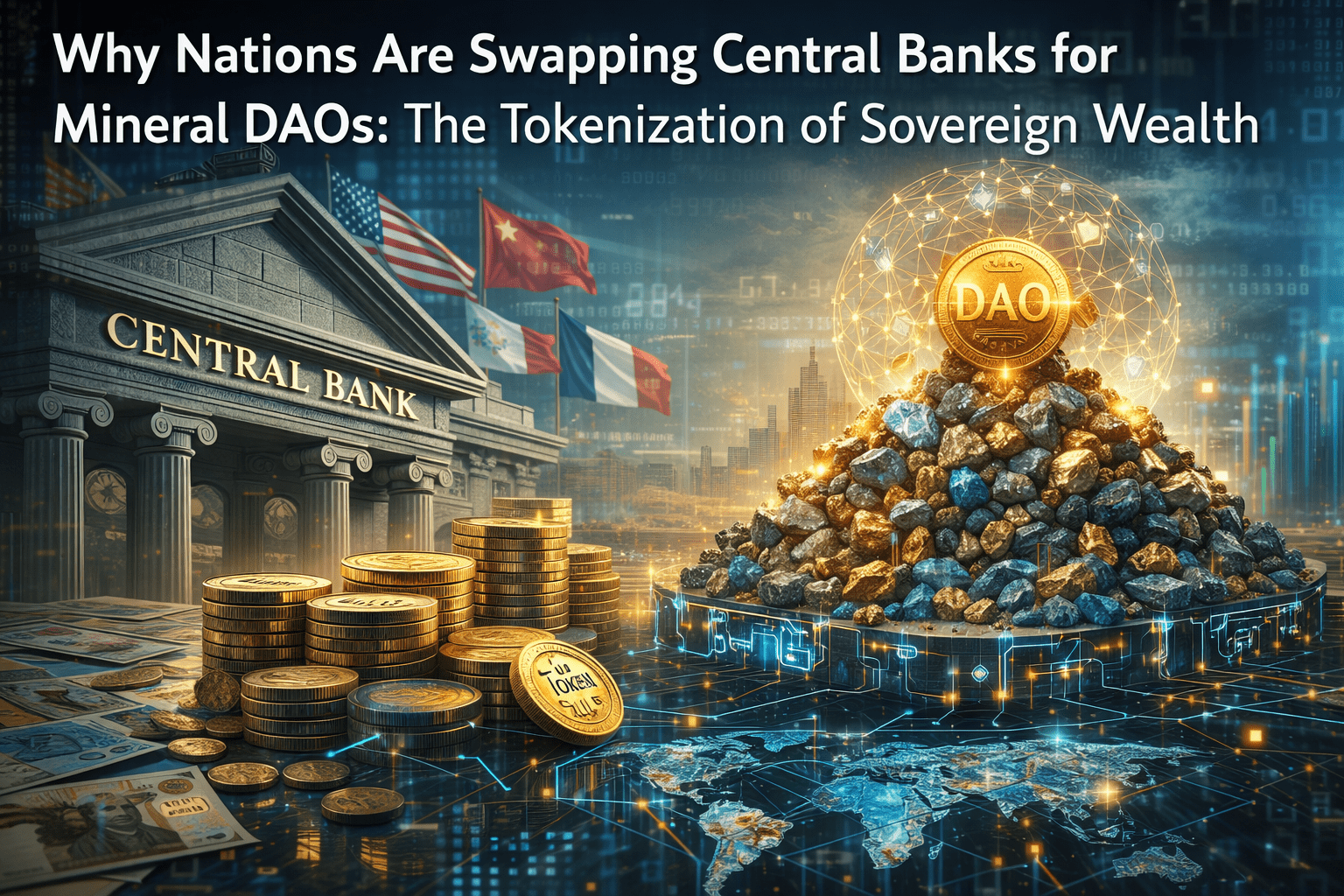
The concept they’re working toward is the Mineral-Backed Decentralized Autonomous Organization, or Mineral DAO: a governance and financial structure that ties a digital asset directly to a verified, real-world commodity, managed by rules encoded in software rather than enforced by institutions that have, in much of the developing world, repeatedly proven untrustworthy. It is an ambitious idea operating at the intersection of blockchain technology, resource economics, and geopolitics. Whether it works depends on problems that are simultaneously technical, political, and deeply human.
What Fiat Money Actually Promises — and Why That Promise Is Breaking
To understand why Mineral DAOs are attracting serious attention, it helps to be precise about what conventional fiat currency actually is and what it requires to function.
A fiat currency is a claim on the productive capacity and institutional integrity of the state that issues it. When you hold US dollars, you are extending a form of trust to the Federal Reserve, the US Treasury, and the full legal and political apparatus that stands behind them — including the US military’s role in maintaining the dollar’s reserve currency status. That trust is well-founded for a small number of countries with deep institutional histories, large and diversified economies, and records of monetary discipline.
For much of Africa and the developing world, none of those conditions reliably hold. The IMF’s own data shows that Sub-Saharan African countries have experienced average annual inflation rates roughly three to four times those of advanced economies over the past two decades. Currency crises, sudden devaluations, and capital flight are not theoretical risks — they are recurring events that have systematically transferred wealth from domestic savers to foreign creditors and political insiders.
The structural problem is what economists call the “impossible trinity”: a country cannot simultaneously maintain a fixed exchange rate, free capital movement, and independent monetary policy. Developing nations caught in this bind typically sacrifice monetary independence — accepting IMF conditionality, dollarizing informally, or watching capital flee to harder assets — or they sacrifice exchange rate stability, condemning domestic savers to inflation erosion.
Mineral DAOs represent a fourth path: anchor monetary value not to institutional credibility but to verified physical assets, using technology to provide the verification that institutions have failed to deliver. It’s a radical idea, but it has a coherent economic logic — and historical precedent. The gold standard, for all its rigidity, worked precisely because it substituted a physical anchor for institutional trust. The question is whether digital technology can update that model for the 21st century.
The Technical Architecture: From Ore to Token
The mechanics of a Mineral DAO involve several layers of technology that are each, individually, reasonably well understood — but whose integration into a functioning sovereign financial system has never been done at scale. Here’s what the architecture looks like in practice.
The Digital Twin Layer
Before any tokenization can occur, you need a credible representation of what you’re tokenizing. In Zambia’s Copperbelt — one of the world’s highest-grade copper deposits — this process begins with aerial surveys using LiDAR-equipped drones that generate centimeter-accurate topographic maps of open-pit operations. Autonomous ground sensors measure ore grade at extraction points, providing continuous quality data. Satellite imagery cross-references surface activity with extraction claims. Together, these data streams feed a “digital twin” — a live, three-dimensional computational model of the mine that updates in near-real-time.
The digital twin serves two functions. For operators, it enables production optimization and predictive maintenance. For investors and auditors, it provides the evidentiary foundation for claims about what the mine is actually producing — the physical basis for any token value.
The Tokenization Layer
Once production data is verified and logged, smart contracts can issue tokens representing fractional ownership of specific quantities of a specific commodity. The design of this token structure matters enormously. A well-designed mineral token isn’t just a receipt for a commodity — it includes embedded logic about redemption rights, transfer restrictions, supply adjustment mechanisms, and governance participation.
In Zambia’s Copper Traceability Initiative, which piloted tokenization between 2024 and 2026, each token represented a verifiable fraction of a specific copper shipment, with provenance data — extraction location, date, grade, and chain of custody — embedded in the token’s metadata. This isn’t just financial engineering; it’s a solution to a longstanding problem in commodity markets where “conflict minerals” and fraudulent provenance claims have plagued everything from cobalt to coltan.
The Oracle Problem
Here is where things get technically treacherous. Blockchain systems are inherently closed — smart contracts can only act on data that exists within the chain. Bringing real-world data (a ton of copper extracted, a shipment loaded) onto the chain requires “oracles”: systems that bridge physical measurements to digital records. Oracle manipulation — feeding false sensor data to a smart contract — is one of the most significant attack vectors in the entire DeFi ecosystem, and the stakes are dramatically higher when the underlying asset is a sovereign nation’s mineral wealth rather than a speculative token.
The most robust implementations use multiple independent oracle providers, cross-referenced against satellite imagery and third-party audit firms, with any single data source incapable of unilaterally updating the token supply. But this adds complexity, cost, and coordination overhead that smaller or less technically sophisticated operations may struggle to maintain.
The DAO Governance Layer
The “decentralized autonomous organization” component addresses how decisions about the mineral DAO are made — changes to token parameters, responses to production disruptions, allocation of revenue. In theory, DAO governance distributes decision-making to token holders, eliminating the central point of failure (and corruption) that characterizes state institutions.
In practice, DAO governance is messy. Voter turnout in major DeFi DAOs rarely exceeds single-digit percentages of eligible participants. Governance attacks — where a single party acquires sufficient tokens to force through self-serving decisions — are a documented phenomenon. And in a sovereign context, the tension between DAO governance and democratic legitimacy is unresolved: if token holders in Singapore and London can vote on Zimbabwe’s lithium extraction policy, is that sovereignty, or is it a new form of financial colonialism with better branding?
The Geopolitical Dimension: Resource Nationalism Gets a Software Upgrade
The economic logic of Mineral DAOs intersects with a political project that has deep roots in African economic thought: resource nationalism. The argument, made by figures from Julius Nyerere to more recent advocates, is that Africa’s persistent underdevelopment is structurally connected to the fact that its mineral wealth has historically been extracted under terms that benefit foreign corporations and creditors more than local populations.
The conventional resource nationalism toolkit — nationalization, export levies, local content requirements — has a mixed track record. Nationalization without management capacity produces state mining companies that are corrupt, inefficient, or both. Export levies invite capital flight and underinvestment. Local content requirements create compliance theater rather than genuine technology transfer.
Mineral DAOs offer a different mechanism for the same political goal. Instead of seizing foreign-owned assets, a government can issue tokens representing production from state-owned mines directly to global investors, bypassing the foreign corporations that traditionally intermediate that transaction. Capital flows in; sovereignty is maintained; and the extraction terms are encoded in smart contracts that neither party can unilaterally rewrite.
Zimbabwe’s ZiG initiative — an acronym for Zimbabwe Gold, though the mechanism extended to lithium — represented an early attempt to execute this strategy. The technical implementation was imperfect, and the geopolitical environment was complicated by existing sanctions, but the underlying political logic was clear: if you can credibly tokenize your mineral wealth, you don’t need Western financial institutions to access Western capital.
The implications extend further than individual countries. Nations controlling critical minerals for the energy transition — lithium, cobalt, manganese, nickel — occupy a structural position in the global economy that is, for the first time in decades, genuinely powerful. Batteries for electric vehicles require these materials. There are no substitutes at scale. As the energy transition accelerates, the countries sitting on these deposits hold cards they’ve never held before.
Mineral DAOs are one mechanism for converting geological endowment into sustained financial leverage rather than a one-time windfall. They create ongoing capital access tied to ongoing production, and they establish price discovery mechanisms that are harder to manipulate than bilateral negotiations with mining multinationals.
Case Study: Congo’s Cobalt Problem and What Tokenization Could Fix
The Democratic Republic of Congo produces roughly 70% of the world’s cobalt, a critical component in lithium-ion batteries. It also exemplifies nearly every problem that Mineral DAOs theoretically address and several that they definitely cannot.
The cobalt supply chain from DRC is haunted by documentation failures. A significant proportion of cobalt — estimates range from 15% to 30% — originates from artisanal and small-scale mining operations (ASM) where child labor, unsafe conditions, and fraudulent provenance documentation are endemic. Tech companies and automakers who depend on cobalt have faced repeated scandals as investigative journalism traces their supply chains back to conditions that are both illegal and lethal.
The Katanga Cobalt DAO pilot, which operated between 2024 and 2026, attempted to address the provenance problem directly. IoT sensors and satellite monitoring tracked extraction at participating industrial mining sites. Each token included embedded provenance metadata, allowing downstream buyers to verify that their cobalt originated from monitored, compliant sources. Early reports suggested institutional buyers — including several European battery manufacturers with ESG commitments — were willing to pay a premium for verifiable provenance, validating the basic economic model.
What the DAO couldn’t fix was the 15–30% of production that occurs outside its monitoring infrastructure entirely. Artisanal miners, who are often desperately poor and lack alternatives, are structurally excluded from a system that requires fixed sensor infrastructure and verified extraction points. The DAO creates a two-tier market: premium-priced verified cobalt for European ESG buyers, and unverified ASM cobalt that continues to flow through traditional channels to less fastidious buyers. This may be better than the status quo — it provides some incentive for industrial operators to meet standards — but it doesn’t solve the underlying problem.
This is a recurring pattern in Mineral DAO pilots: the technology works well for large, stable, fixed-point industrial operations and much less well for the informal and artisanal mining sectors that employ the most vulnerable workers and produce the most documentation problems.
The Challenges That Are Actually Hard
Proponents of Mineral DAOs sometimes present the technology as a solution to problems that the technology cannot, in fact, solve. A clear-eyed assessment requires distinguishing between challenges that are difficult engineering problems and challenges that are fundamental constraints.
Commodity price volatility is a fundamental constraint, not an engineering problem. Lithium prices fell by more than 80% between their 2022 peak and 2024 trough. A nation that has structured its fiscal planning around lithium token revenue faces the same budget crisis as one that simply sold lithium on spot markets — the blockchain layer doesn’t provide any price stability. Nations considering Mineral DAO structures need sophisticated commodity hedging strategies that are, ironically, most available through the traditional financial institutions the DAO is designed to bypass.
“Ghost mines” are a real and underappreciated risk. Territorial disputes, civil conflict, and infrastructure failure can make mines physically inaccessible. When this happens, tokens remain on the blockchain while the underlying asset becomes unreachable. Investors in the DRC’s mining sector have experienced exactly this dynamic — the mineral wealth is real, but accessing it requires operating in conditions that periodically make that impossible. No governance structure encoded in smart contracts can fix a conflict that requires political resolution.
The regulatory environment is actively hostile in some jurisdictions. Several G7 countries have existing or proposed regulations that would restrict trading in digital assets tied to sanctioned jurisdictions — which includes both Russia and Iran and several African countries at various times. A Mineral DAO structured to raise capital from European or American investors faces regulatory risks that its architects in Harare or Kinshasa may not fully appreciate, and those risks can materialize suddenly when the geopolitical environment shifts.
Technical capture is a new form of an old problem. Who controls the oracle infrastructure? Who writes the smart contract code? Who audits the sensor data? If the answer to all of these questions is a small number of Western technology companies — which it currently is, for most pilots — then Mineral DAOs may replicate the dependency structure they’re designed to escape, just with software engineers instead of investment bankers as the intermediaries.
What a Mature Mineral DAO Ecosystem Might Actually Look Like
Strip away both the utopian framing and the reflexive skepticism, and Mineral DAOs represent a genuine and potentially significant financial innovation — one with a plausible path to maturity, if the implementation challenges are addressed seriously.
A well-functioning mineral token market would probably look less like a replacement for central banking and more like a sophisticated commodity securitization system with blockchain-based verification. Sovereign mineral funds — analogous to Norway’s Government Pension Fund or Chile’s Economic and Social Stabilization Fund — could use tokenization to improve liquidity and transparency without abandoning the macroeconomic management functions that central banks perform. Tokens could serve as collateral for domestic currency issuance, replicating the gold standard’s anchoring function without its deflationary rigidity.
The governance structure of mature implementations would likely involve institutional investors (sovereign wealth funds, pension funds, multilateral development banks) as anchor token holders, providing the liquidity and due diligence infrastructure that retail token markets cannot. These investors have existing relationships with commodity audit firms, know how to price sovereign risk, and have compliance infrastructure for cross-border investment that small token platforms lack.
Environmental and labor standards would probably need to be incorporated directly into token issuance conditions — not as optional ESG overlays but as hard requirements encoded in smart contracts, with independent audit verification as a precondition for token generation. This would exclude ASM-sourced production from the premium market but might create incentives for formalizing artisanal operations over time.
Conclusion: The Map Is Not the Territory
The phrase “the map is not the territory” is credited to the philosopher Alfred Korzybski, who used it to warn against confusing representations of reality with reality itself. It is, perhaps, the single most important caution for anyone evaluating Mineral DAOs.
The digital twin of a cobalt mine is a representation. The token is a representation. The smart contract is a set of rules about representations. The underlying reality — the geology, the geopolitics, the labor conditions, the commodity market — is the territory, and it will continue to do what territories do: change in ways that no map fully anticipates.
What Mineral DAOs can genuinely offer is better maps — more transparent, more frequently updated, more resistant to falsification than the paper-based systems they replace. In contexts where institutional trust has been systematically destroyed by decades of mismanagement and corruption, better maps matter. They can enable capital access that wasn’t previously possible, reduce the information asymmetries that allow intermediaries to extract rents, and create accountability mechanisms that have real teeth.
What they cannot offer is a technological solution to fundamentally political problems. Resource governance in post-colonial states involves questions about who benefits from extraction, who bears the environmental costs, and who has political voice in decisions about national resources. These are questions about power, not software architecture. Technology can make those questions easier to ask and harder to evade. It cannot answer them.
The era of pure paper promises in developing world finance is, genuinely, ending. Whether what replaces it is meaningfully better will depend less on the sophistication of the blockchain infrastructure and more on whether the political conditions exist to use that infrastructure in service of populations rather than just investors.
That is a question that no DAO can decentralize.
This article is part of a series examining the intersection of emerging financial technologies and sovereignty in the developing world.