The Night the Servers Went Dark
The alert arrived at 2:47 a.m. Singapore time — not with a bang, but with a silence. One moment, the sensor dashboard for the Manono lithium concession in the eastern Democratic Republic of Congo was streaming its usual telemetry: extraction tonnage, conveyor belt throughput, humidity readings from shafts sunk forty meters into one of the world’s richest deposits of the mineral that powers the global electric vehicle economy. Then, in the space of a single refresh cycle, every node went dark. Not one instrument. All of them. Simultaneously.
In the operations center overlooking Marina Bay, a junior analyst stared at a wall of grey screens and did what any rational person would do at 2:47 a.m.: he assumed a network outage. He logged a ticket, poured a coffee, and waited for the system to come back online.
It never did. Because this was not a network outage.
Four thousand miles away, in the red-dust highlands of Tanganyika Province, a column of armed men from a regional militia had spent the previous six hours cutting through the perimeter of the concession. They were not interested in the lithium. Not directly. They were interested in the infrastructure that monitored it — the satellite uplink towers, the ruggedized sensor arrays bolted to excavation machinery, the small concrete building housing the local server stack that fed live data to the DAO’s smart contract system. Within ninety minutes, that building was rubble, the uplinks were down, and the physical asset underpinning a $340 million tokenized commodity fund had, in any meaningful operational sense, ceased to exist.
By 3:15 a.m. Singapore time, the token was in freefall.
It did not fall because anyone in the market knew what had happened. The information did not exist yet in any form that the financial system could process. It fell because the silence itself was data — because algorithmic trading systems, trained to interpret the cessation of telemetry as a risk signal, began liquidating positions the moment the sensor feed flatlined. It fell because a handful of traders with contacts in eastern Congo had received fragmented WhatsApp messages from local employees, and they acted before any formal disclosure was possible. It fell, most fundamentally, because the market understood something that the technology had not yet formally acknowledged: that the relationship between the token and the thing the token was supposed to represent had just been severed.
This is the scenario that the architects of the tokenized real-world assets revolution — the founders, the protocol designers, the institutional investors who have poured billions into the premise that blockchain technology can bring transparency and liquidity to historically opaque commodity markets — have spent the least time engineering against. The whitepapers are meticulous on cryptographic security. They are thorough on governance mechanisms, on oracle network design, on the conditions under which smart contracts will execute. What they are not thorough on is mud. Or militias. Or the precise sequence of events that unfolds when the physical asset at the base of the entire financial structure is no longer accessible to the people who built the structure around it.
In 2026, the tokenized commodities market has matured to the point where this is no longer a theoretical concern. Mineral DAOs — decentralized autonomous organizations that issue tokens backed by physical mining rights, extraction quotas, or proven mineral reserves — manage assets across some of the most resource-rich and geopolitically volatile terrain on earth. The DRC alone holds an estimated 70 percent of the world’s cobalt reserves and has not experienced a decade of uninterrupted political stability in living memory. Guinea controls over half of global bauxite production and has seen two military coups since 2020. Mali, Burkina Faso, Niger — the Sahel’s mineral corridor is simultaneously one of the most strategically vital and most chronically unstable regions on the planet.
The promise of mineral tokenization was always that it could democratize access to these assets — that a retail investor in Rotterdam or a pension fund in Seoul could hold a fractional, liquid, transparent claim on a cobalt mine or a lithium deposit without the opacity and inaccessibility that have historically kept these markets in the hands of a small number of well-connected commodity trading houses. That promise has not disappeared. But it has collided, with increasing force and frequency, with the fundamental truth that no token, however elegantly constructed, can alter the physical reality of the asset it represents.
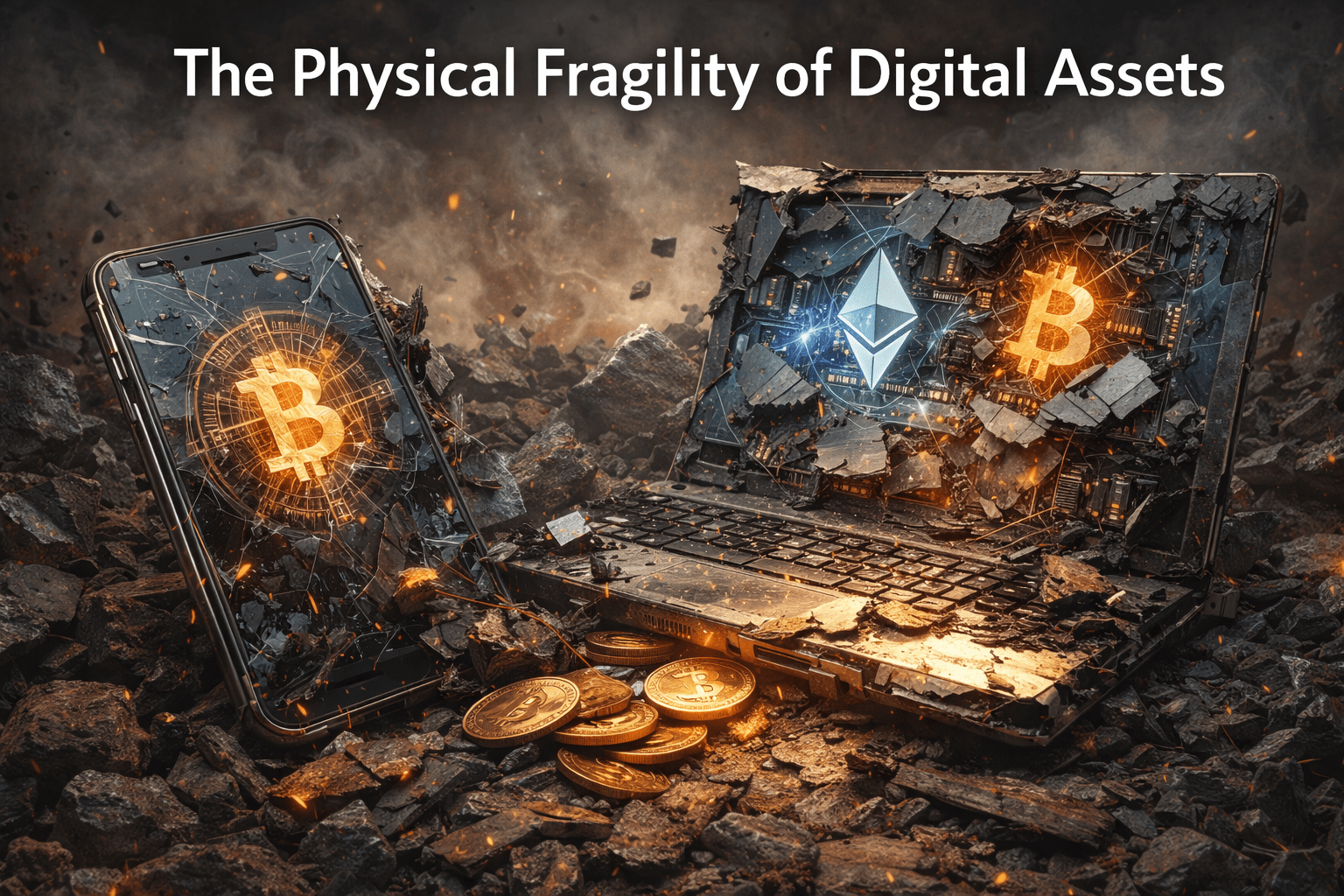
The greatest risk to a Mineral DAO in 2026 is not a digital hack. It is not a smart contract exploit. It is not even a regulatory intervention, though those remain live threats. It is what practitioners have begun calling the Physical-to-Digital Disconnect — the moment when the chain of trust between a token and its underlying mineral is broken not by code, but by the world. By weather. By war. By the oldest and most intractable forces in human history, none of which have ever been particularly impressed by a cryptographic proof of ownership.
The Ledger Says You Own It. The Gunmen Disagree.
On the morning of September 14th, 2024, the transitional government of a West African nation — its name withheld here pending ongoing legal proceedings — announced the issuance of 50 million “Cobalt Tokens” on a public blockchain. The stated purpose was straightforward, if ambitious: to raise hard currency for national infrastructure development by offering international investors a digitally transferable, blockchain-verified claim on extraction rights to a cobalt deposit in the country’s interior. The token sale raised $180 million in seventy-two hours. The whitepaper was professionally produced. The auditors were reputable. The smart contract code had been reviewed by two independent security firms. By every metric that the digital asset industry uses to evaluate legitimacy, this was a credible instrument.
Fifty-three days later, a rebel coalition seized the mine.
The soldiers who took up positions around the perimeter had no awareness of, and no interest in, the blockchain. They were not making a statement about decentralized finance. They were pursuing a territorial and resource agenda that predated the token sale by several years, driven by a regional dispute over extraction revenues that the transitional government had, critics would later allege, partially financed through the token sale itself. The cobalt was still in the ground. The extraction infrastructure was largely intact. But the organization with the legal mandate — however contested — to operate that infrastructure had lost physical control of the site. The armed group now controlling it had no legal mandate of any kind and no intention of honoring one.
In Singapore, London, and Dubai, 4,300 individual token holders were still looking at wallets that said they owned a fractional share of a cobalt deposit. They did, in the only sense that the blockchain could verify. The ledger had not changed. The code had not changed. The physical reality had changed entirely.
This is what researchers at the intersection of commodity finance and distributed ledger technology have begun calling the Ghost Asset — a token that continues to trade, to be priced, to be held and transferred and used as collateral, even though the physical asset it represents has become inaccessible, destroyed, or seized by a party with no relationship to the token structure whatsoever. The term carries a deliberate double meaning. The asset haunts the market: present enough to move prices, real enough to appear on balance sheets, but impossible to actually touch or claim.
The parallel to the classical double-spend problem in cryptocurrency is instructive, even if the mechanism is inverted. In a double-spend attack, the same digital asset is spent twice because the ledger is manipulated. In the Ghost Asset scenario, the manipulation is not on the ledger at all — the ledger is functioning perfectly. The problem is that the physical asset has effectively been “spent” by an entirely external actor who is completely outside the system. The mine has been seized once in the real world. But in the digital world, it has been claimed — and continues to be claimed — by thousands of token holders simultaneously. There is no technical mechanism within the smart contract architecture to reconcile these two realities, because the smart contract has no way of knowing that the second reality exists.
The financial consequences of this disconnect are not abstract. When Ghost Assets continue trading, they create a category of market behavior that sits somewhere between a distressed asset and an outright fraud, without being cleanly either. Token holders who understand the ground situation may sell, driving prices down and transferring losses to buyers who do not yet have the same information. In illiquid markets — and many mineral token markets remain relatively illiquid outside of peak trading hours — a single large informed seller can trigger a cascade that destroys value far in excess of what the underlying disruption would rationally justify. Conversely, if information about a physical seizure is suppressed or slow to emerge, tokens may continue trading near par value for days or weeks after the asset has become unrecoverable, creating the conditions for what securities regulators in the United States and European Union have both flagged as a potential new category of market manipulation.
The jurisdictional question compounds everything. The cobalt deposit is in West Africa. The DAO governing the token structure is incorporated — to the extent that it is incorporated at all — in the Cayman Islands. The smart contracts run on a blockchain with nodes distributed across forty countries. The token holders are in Singapore, London, Dubai, Seoul, and São Paulo. The rebel group controlling the mine recognizes none of these entities and is subject to no legal framework that any of them can invoke. When token holders began attempting to organize a legal response in the weeks following the seizure, they discovered that there was no single jurisdiction in which their claim was clearly actionable, no defendant against whom a conventional property rights case could be filed, and no enforcement mechanism that could bridge the gap between a cryptographic proof of ownership and the physical reality of armed men at a mine entrance.
This is the Smart Contract Paradox in its starkest form. The code is not wrong. It accurately reflects what was agreed, what was recorded, and what the ledger shows. But code operates within a system of assumptions — assumptions about the continuity of legal frameworks, the enforceability of property rights, the stability of the physical environment — that the real world is under no obligation to honor. A smart contract can execute with perfect fidelity and still be completely useless if the asset it governs has been removed from the domain in which the contract has any practical authority.
The more sophisticated architects of mineral DAO structures have begun trying to engineer around this problem through what might be called layered sovereignty clauses — contractual provisions, sitting outside the smart contract itself, that attempt to specify governing law, dispute resolution mechanisms, and enforcement pathways in the event of physical disruption. These provisions are genuinely innovative, and in politically stable jurisdictions with functioning court systems, they may prove effective. But they face an irreducible problem: the regions where mineral tokenization is most commercially attractive — where the deposits are largest and least exploited, where the potential returns are highest — are precisely the regions where layered sovereignty clauses are least likely to be enforceable. The legal architecture is most sophisticated exactly where the legal environment is most hostile to it.
The cobalt token case remains unresolved. The tokens still trade, at roughly eleven cents on the dollar against their issuance price. Some holders have written off the loss. Others are pursuing claims through international arbitration panels with uncertain jurisdiction and no enforcement power over the territory in question. The mine continues to operate, sporadically, under the control of the rebel coalition, which has begun selling cobalt through informal regional trading networks entirely disconnected from the token structure. The ledger still shows 50 million tokens in circulation. The ledger is, in every technical sense, correct.
It is simply describing a ghost.
The Machines That Were Supposed to Never Lie
The entire theoretical edifice of the mineral DAO rests on a deceptively simple premise: that the physical world can be accurately, continuously, and tamper-resistedly translated into data that a smart contract can trust. The instrument of that translation is the oracle — a term borrowed from classical antiquity with an irony that grows more apparent the deeper you examine the technology. Ancient oracles were famously ambiguous, politically compromised, and occasionally fabricated their prophecies entirely. The blockchain oracle, its architects insist, is none of these things. It is a network of hardened IoT sensors, satellite uplinks, and cryptographically signed data feeds that pipes verified real-world information directly into the smart contract layer, triggering automated responses — token minting, redemptions, collateral adjustments — based on what the physical asset is actually doing at any given moment.
In controlled environments, with well-maintained infrastructure, in politically stable jurisdictions with reliable communications networks, this architecture works remarkably well. The problem is that controlled environments, well-maintained infrastructure, and political stability are precisely the conditions least likely to prevail in the regions where mineral DAOs operate. And when the oracle fails — when the pipe between the physical world and the digital contract is severed, corrupted, or deliberately subverted — the consequences cascade through the system in ways that the technology was not designed to absorb.
The failure modes are more varied and more ingenious than most investors appreciate.
Hardware Sabotage: The Lowest-Tech Attack on the Highest-Tech System
The first and most direct method requires no technical sophistication whatsoever. The ruggedized IoT sensor arrays deployed at mining sites — the devices that measure extraction tonnage, equipment utilization, geological stability, and a dozen other variables that feed into the oracle network — are physical objects bolted to physical machinery in physical locations that can be reached by physical human beings. They can be covered with material that blocks their optical or thermal sensors. They can be immersed in water. They can be removed entirely and replaced with devices that broadcast pre-recorded data streams. They can, most simply of all, be destroyed with a hammer.
This is not a hypothetical vulnerability. Security researchers at Imperial College London documented multiple cases in a 2024 study where IoT sensors deployed at tokenized agricultural and extractive sites had been physically tampered with by local actors seeking to manipulate the data feeds that determined token issuance rates and collateral valuations. In several cases, the tampering had gone undetected for periods ranging from eleven days to — in one exceptional case — seven weeks, during which time the oracle continued to report normal operations to the smart contract while the physical site was either underperforming, idle, or operating under unauthorized management.
The detection challenge is structural. Oracle networks are designed to identify anomalous data — readings that fall outside expected parameters — as a signal of potential tampering or malfunction. But a sophisticated local actor who understands the expected parameter ranges can calibrate a spoofed data feed to remain within those ranges indefinitely, reporting plausible but fictional extraction figures while the actual physical situation has diverged completely. The oracle does not know it is lying. It is, from a purely technical standpoint, functioning exactly as designed. The deception is upstream of the technology, in the physical layer that the technology was always dependent on but never fully controlled.
Satellite communication jamming presents a related but distinct threat vector. The sensor arrays at remote mining sites typically relay their data via satellite uplink — a communication pathway that is vulnerable to both deliberate jamming by actors with relatively accessible radio frequency equipment and to the kind of inadvertent signal disruption caused by the atmospheric and geographic conditions common to equatorial mining regions. The International Telecommunication Union has documented a significant increase in deliberate satellite jamming incidents across sub-Saharan Africa since 2022, a trend driven primarily by military and paramilitary actors for whom controlling information flows about resource extraction has become a strategic priority. For a mineral DAO whose oracle network depends on uninterrupted satellite connectivity, a sustained jamming operation does not need to corrupt any data at all. It simply needs to prevent data from arriving. And silence, as the Singapore operations center discovered at 2:47 a.m., is its own kind of message.
The Black Swan Beneath the Surface
If hardware sabotage represents the human threat to oracle integrity, the geological and climatological environment represents a threat of an entirely different character — one that is, in some respects, harder to engineer against because it operates without intent or strategy.
The regions that host the world’s most significant untapped mineral deposits are, with striking geographic regularity, also among the most climatologically extreme environments on earth. The lithium-rich salt flats of the Atacama sit at altitudes where equipment failure rates run significantly higher than manufacturer specifications. The cobalt and coltan deposits of the eastern DRC lie within a region that experiences some of the most intense convective rainfall on the planet, with annual precipitation figures that regularly exceed 2,000 millimeters and flash flooding events that can render mine access roads impassable for weeks at a time. The nickel deposits of Sulawesi and the rare earth concentrations of Myanmar’s Kachin State both sit in zones of significant seismic activity. These are not edge cases. They are the standard operating environment for the assets that mineral DAOs are tokenizing.
In February 2025, a series of exceptionally heavy rainfall events in Guinea’s Boké Prefecture — home to roughly a third of the world’s known bauxite reserves — triggered a sequence of landslides that rendered three separate mining concessions inaccessible for an aggregate period of six weeks. The minerals were not destroyed. They remained exactly where they had always been, undisturbed in geological formations that had persisted for millions of years. But the infrastructure required to extract them — the haul roads, the processing facilities, the port access routes — had been sufficiently damaged that extraction was physically impossible. For the token holders whose instruments were backed by extraction quotas from those concessions, the distinction between “the mineral is destroyed” and “the mineral cannot be extracted” was financially irrelevant. The token’s value derived not from the existence of the mineral but from the cash flow generated by its extraction. No extraction meant no cash flow. No cash flow meant no fundamental basis for the token’s valuation.
The oracle networks at two of the three affected concessions continued to report during the disruption period — accurately, as it happened, faithfully transmitting sensor readings that showed mining equipment stationary and extraction volumes at zero. The smart contracts received this data and interpreted it correctly as an operational shutdown. What they could not determine, because no oracle had been designed to answer this question, was whether the shutdown was temporary or permanent, recoverable or catastrophic, a matter of days or of months. The contracts had no protocol for this ambiguity. They were engineered for precision — for clear threshold conditions that would trigger clear automated responses. They had not been engineered for the particular kind of uncertainty that the physical world specializes in generating.
Oracle Lag: The Window Where Fortunes Are Lost
Of all the failure modes in the physical-to-digital translation chain, the most financially consequential may be the one that receives the least attention in technical documentation: the lag between a physical event and its recognition by the smart contract system.
Even in a scenario where hardware is functioning perfectly, satellite communications are uninterrupted, and no deliberate tampering has occurred, there is an irreducible delay between the moment a physical event happens and the moment its full implications are captured, transmitted, verified, and acted upon by the oracle network. For routine operational data — extraction tonnage, equipment status, geological readings — this lag is typically measured in minutes and is operationally insignificant. For catastrophic events, the lag can stretch into hours or days, and the financial consequences of that window can be severe.
The mechanism is straightforward. When a significant physical disruption occurs at a mine — a flooding event, a structural collapse, a security incident — the information does not arrive at the oracle network as a single, definitive, machine-readable signal. It arrives as a chaotic, partial, and often contradictory stream of data from multiple sources: sensor readings that may reflect only one dimension of the event, satellite imagery that may be obscured by weather or cloud cover, reports from on-site personnel that may be incomplete or inaccessible if communications infrastructure has been damaged. The oracle network must aggregate and interpret this stream before it can generate the kind of clean, verified signal that the smart contract is designed to act upon. That process takes time.
During that window, the market is not standing still. Human traders with partial information — the WhatsApp messages from mine workers, the satellite phone calls from site managers, the first fragmentary reports on regional news services — are already acting. By the time the oracle network has generated a verified signal and the smart contract has updated its state, the informed segment of the market has already repriced the asset. What follows is not a market reacting to new information. It is a market catching up to information that a subset of participants have already exploited. The result is a pattern of trading that regulators in multiple jurisdictions have begun examining with considerable interest, and which token holders on the wrong side of the information asymmetry experience as something that feels, functionally, indistinguishable from front-running.
Chainlink’s 2025 infrastructure report — the oracle network that underpins a significant proportion of the tokenized real-world asset market — acknowledged oracle lag as an active area of development, noting that the challenge of achieving sub-minute verification latency for complex physical events in low-connectivity environments remains, in its own carefully chosen words, “an open engineering problem.” In the lexicon of technical documentation, that phrase carries the weight of an admission. It means the problem has not been solved. It means the window exists. And it means that for as long as it exists, the physical catastrophe and the smart contract’s recognition of it will be separated by a gap through which significant sums of money will continue to flow in the wrong direction.
The oracle was supposed to be the bridge between the geological and the digital — the instrument that made the ancient economy of extraction legible to the instant economy of the blockchain. In the right conditions, it performs that function with impressive fidelity. But bridges, by definition, can only span the distance between two stable points. When one of those points is a cobalt mine in eastern Congo or a bauxite concession in a Guinean flood plain, the stability of the foundation is never guaranteed. And when the bridge fails, it does not fail quietly. It fails in the middle of a crossing, with the full weight of the market standing on it.
The Courthouse That Doesn’t Exist
In the spring of 2025, a consortium of European investors holding tokens in a lithium DAO with extraction rights in the Manono concession of the DRC retained a team of international lawyers and asked them a question that seemed, on its surface, straightforward: who do we sue?
Eighteen months later, they are still waiting for a definitive answer.
This is not because their lawyers are incompetent. The firms involved include practices with decades of experience in international mining law, cross-border arbitration, and digital asset regulation. It is because the question itself — deceptively simple, structurally devastating — exposes a jurisdictional vacuum at the heart of the mineral DAO model that no amount of legal ingenuity has yet managed to fill. The tokenized commodity market has, in its rush to engineer cryptographic solutions to financial problems, constructed an asset class that exists simultaneously in too many legal jurisdictions to be cleanly governed by any of them, and in too few to be protected by the mechanisms that govern conventional commodity investments.
To understand why, it helps to map the layers of the problem with some precision.
The Jurisdictional Stack
A typical mineral DAO token structure in 2026 involves, at minimum, five distinct jurisdictional layers, each with its own legal framework and none of which maps cleanly onto the others.
The first is the physical asset layer: the mine itself, located in a sovereign nation with its own mining law, property rights framework, and — critically — its own political and security situation. In the DRC, mining rights are governed by the 2018 Mining Code, a substantially revised framework that introduced higher royalty rates and state participation requirements, and which has been subject to ongoing interpretation disputes between the government, international mining companies, and provincial authorities. The code says nothing about tokenized ownership structures, because it was written before they existed at a meaningful scale. Its silence on this point is not neutral — it is a vacuum that opposing parties in any dispute will attempt to fill with interpretations favorable to their own interests.
The second layer is the DAO governance layer: the organizational structure through which token holders exercise collective rights over the asset. Most mineral DAOs are structured to minimize regulatory exposure by avoiding incorporation in jurisdictions with aggressive securities regulation. The practical result is a governance entity that may be nominally domiciled in the Cayman Islands, the British Virgin Islands, or increasingly in jurisdictions like the Marshall Islands, which passed the DAO Act in 2022 specifically to provide legal personhood for decentralized organizations. Each of these jurisdictions has different rules about member liability, governance obligations, and — most relevantly — the standing of token holders to bring legal claims on behalf of the organization.
The third layer is the token issuance layer: the jurisdiction whose securities law governs whether the token constitutes a regulated financial instrument and, if so, what disclosure and investor protection obligations apply. The United States, the European Union, the United Kingdom, and Singapore have each developed distinct regulatory frameworks for tokenized real-world assets, and none of them are fully harmonized. A token that qualifies as a security under the SEC’s Howey Test may not meet the threshold for classification as a financial instrument under the EU’s Markets in Crypto-Assets regulation. A token structured to comply with MiCA may inadvertently trigger disclosure obligations under the UK’s Financial Services and Markets Act. The compliance architecture required to navigate all of these simultaneously is sufficiently complex that most mineral DAOs have chosen, in practice, to navigate none of them — issuing tokens in regulatory grey zones and hoping that the pace of regulatory development does not catch up with their operational timeline.
The fourth layer is the smart contract layer: the blockchain on which the token operates, which is governed by no jurisdiction at all in any conventional legal sense, and which will execute its programmed instructions regardless of what any court in any country orders. This is, in the marketing of decentralized finance, presented as a feature. In a legal dispute, it is a profound complication. A court order freezing the assets of a conventional financial instrument can be enforced through the custodial institutions that hold those assets. A court order relating to tokens on a public blockchain has no custodial institution to serve it on. The tokens will continue to trade, to be transferred, and to be used as collateral until the private key holders choose to comply with the order — which, in a decentralized structure with thousands of anonymous holders, may mean never.
The fifth and final layer is the enforcement layer: the practical question of who can compel compliance with any legal determination that emerges from navigating the previous four layers. In a dispute involving a mine in the DRC and token holders in Singapore, a favorable ruling from a Cayman Islands court has no automatic enforcement mechanism in either the DRC or Singapore. A Singapore arbitration award has no mechanism for compelling a DAO with no assets in Singapore to pay. And neither has any mechanism whatsoever for compelling an armed group in eastern Congo to vacate a mine they currently control by force.
The Smart Contract Paradox, Revisited
The legal impossibility of mineral DAO disputes is not merely a procedural inconvenience. It represents a fundamental tension between two incompatible theories of ownership that the tokenization movement has never fully resolved.
The blockchain theory of ownership holds that possession of a private key constitutes definitive proof of ownership of the associated asset. This theory is internally coherent and technically robust. It is also, when applied to physical assets, a philosophical claim rather than a legal one — and one that the physical world has no obligation to honor. The legal theory of ownership, by contrast, holds that property rights are social constructs enforced by the coercive power of the state, and that they are only as durable as the state’s capacity and willingness to enforce them. This theory is less elegant than the blockchain version. It is considerably more accurate as a description of how the world actually works.
When these two theories collide — when a token holder’s cryptographic proof of ownership meets an armed group’s physical control of the underlying asset — the result is not a legal dispute in any conventional sense. It is a confrontation between two systems that share no common language, no common authority, and no common mechanism for resolution. The token holder cannot compel the armed group to recognize the blockchain. The armed group cannot invalidate the token holder’s cryptographic claim. They exist in parallel realities, each internally consistent, each completely impervious to the other.
The Emergence of Enforcement DAOs
The recognition of this impasse has given rise to one of the more remarkable developments in the mineral DAO ecosystem of 2025 and 2026: the emergence of what practitioners have begun calling Enforcement DAOs — hybrid structures that attempt to bridge the gap between cryptographic ownership and physical control through a combination of private security contracting, political risk insurance, and on-chain governance mechanisms.
The basic model works as follows. A mineral DAO, at the point of token issuance, allocates a portion of its treasury — typically between three and eight percent of total capital raised — to a dedicated security and enforcement fund governed by a separate smart contract. This fund is used to retain a private security contractor with experience operating in the relevant jurisdiction, whose mandate includes physical site protection, intelligence monitoring of regional security conditions, and — in the event of a physical disruption — the capacity to conduct what the contracts carefully describe as “asset recovery operations.” The security contractor’s performance obligations are encoded, to the extent possible, in verifiable metrics: site access maintenance, sensor network uptime, response time to physical intrusion events.
Companies operating in this space include established political risk consultancies that have expanded their mandates into the DAO ecosystem, as well as newer entrants specifically formed to serve the tokenized asset market. Nardello & Co, the global investigations and risk advisory firm, and Control Risks are among the established players that have developed practices specifically addressing the physical security requirements of tokenized real-world assets. Their involvement represents a significant evolution in the risk management architecture of the sector — and also a frank acknowledgment that the gap between cryptographic and physical ownership is real, persistent, and cannot be closed by engineering alone.
The limitations of the Enforcement DAO model are, however, significant. Private security contractors can protect infrastructure in relatively permissive environments. They cannot, in practice, retake a mine seized by a well-armed rebel faction operating with state-level equipment and regional political support. Their intelligence capabilities can provide early warning of deteriorating security conditions — valuable for triggering oracle updates and giving token holders time to exit positions before a crisis fully develops. They cannot prevent the crisis itself. And in the most extreme scenarios — full state seizure, prolonged civil conflict, complete breakdown of regional governance — their mandate becomes effectively unexecutable, and the fund allocated to retain them represents a further loss layered on top of the underlying asset loss.
The insurance protocols that have developed in parallel with Enforcement DAOs attempt to address this residual risk, but they face their own set of structural challenges. Pricing physical breach risk for a cobalt mine in eastern Congo requires actuarial data that does not yet exist at meaningful scale. The underwriters entering this market are, by necessity, making educated guesses about tail risk probabilities in environments that have historically confounded much more sophisticated risk models than any currently available. Several on-chain insurance protocols have begun offering “Physical Breach” coverage for tokenized real-world assets — a development we will examine in detail in the following section — but the coverage limits currently available fall well short of the asset values being tokenized, and the claims processes for physical breach events involve exactly the kind of contested factual determinations that decentralized governance mechanisms are least equipped to resolve efficiently.
The courthouse, in other words, does not exist. What exists instead is an improvised architecture of private security contractors, jurisdictional arbitrage, insurance protocols, and governance clauses — each piece addressing one dimension of the enforcement problem, none of them addressing it whole. For token holders seeking recourse after a physical disruption, this architecture offers something. It does not offer justice, in any sense that the word has conventionally implied. It offers, at best, a structured process for negotiating the size of the loss.
That may be the most honest thing that can be said about the legal framework governing mineral DAOs in 2026. Not that it fails catastrophically. But that it was never, despite the sophistication of its component parts, designed to succeed completely. It was designed to manage the gap between two worlds that speak different languages and obey different laws. And managing a gap is not the same as closing it.
Hedging the Unhedgeable: How the Market Is Learning to Price Chaos
For most of the history of commodity investment, political risk was someone else’s problem. The mining companies that extracted cobalt from the Katanga plateau or lithium from the Atacama carried that risk on their own balance sheets, priced it into their cost of capital, and managed it through a combination of government relations, private security, and — when those failed — write-downs that their institutional shareholders absorbed with the practiced equanimity of people who had always understood that digging valuable things out of unstable ground was not a risk-free enterprise. The investors who bought shares in those companies were insulated from the raw physical risk by several layers of corporate structure, legal personhood, and balance sheet depth. The mine could be seized. The company would survive, diminished, and continue.
The mineral DAO model eliminated those layers deliberately. That was the point. By removing the corporate intermediary and connecting investors directly to the underlying asset through a token, DAOs promised transparency, liquidity, and democratized access that the old model could never deliver. What they also delivered, without always advertising it prominently in their offering documents, was direct exposure to every risk that the corporate intermediary had previously absorbed. The upside of disintermediation is genuine. So is the downside. And in 2026, the insurance market is in the early, turbulent stages of trying to price that downside — a task that requires putting actuarial numbers on scenarios that have no historical precedent at meaningful scale.
The On-Chain Insurance Frontier
The most structurally innovative responses to physical breach risk have emerged not from the traditional insurance industry but from within the decentralized finance ecosystem itself — a development that is either encouraging evidence of the market’s capacity for self-correction or a concerning sign that the sector is attempting to insure its own tail risks with its own capital, depending on your degree of skepticism about the overall enterprise.
Nexus Mutual, the decentralized insurance protocol that pioneered on-chain coverage for smart contract failures, has been the most prominent mover in this space. Originally focused exclusively on digital risks — smart contract exploits, exchange hacks, oracle manipulation — Nexus Mutual began piloting coverage for physical asset disruption in late 2024, responding to member demand from the growing tokenized real-world asset sector. The coverage framework it developed, which it terms “Physical Infrastructure Protection,” attempts to provide token holders with compensation in the event that a covered physical asset becomes inaccessible or unoperational due to a defined set of external causes: armed conflict, natural disaster, state seizure, and critical infrastructure destruction.
The structural challenges of designing this coverage were considerable, and the solutions Nexus Mutual arrived at reveal both the ingenuity and the limitations of the on-chain insurance approach. The most fundamental challenge was the claims verification problem. Conventional insurance claims for physical damage are assessed by human adjusters who inspect the affected asset, gather evidence, and make determinations about cause and extent of loss. In a decentralized insurance protocol, claims are assessed by token-weighted governance votes — a mechanism that works reasonably well for digital risks, where the evidence is on-chain and verifiable by any participant, but that struggles considerably with physical risks, where the evidence is in a flooded mine shaft in Guinea or a rebel-controlled concession in the DRC.
Nexus Mutual’s solution was to introduce a hybrid claims assessment model that combines on-chain governance with off-chain evidence requirements. A claim for physical breach must be supported by a minimum evidence package: satellite imagery from at least two independent providers confirming site inaccessibility, a signed attestation from the DAO’s appointed security contractor, and — where available — contemporaneous reporting from at least three independent journalistic or intelligence sources. This evidence package is submitted on-chain and made available to all Nexus Mutual members participating in the claims assessment vote. The model is imperfect — satellite imagery can be ambiguous, security contractor attestations are not fully independent, and journalistic coverage of remote mining incidents in politically sensitive regions is often sparse and delayed. But it represents a genuine attempt to bring verifiable physical evidence into a governance framework designed for digital verification, and its architects are candid about the iterative nature of the process.
Unslashed Finance and InsurAce Protocol have developed parallel frameworks with varying approaches to the evidence and governance challenges. What all of these protocols share is a common constraint: coverage capacity. The total capital available across all on-chain insurance protocols for physical breach coverage of tokenized real-world assets remains, as of early 2026, a fraction of the total value of assets being tokenized. The gap between insurable capacity and insured exposure is not a minor calibration problem. It is a structural feature of a market that is growing faster than the risk capital available to support it — a pattern that students of financial history will recognize as a precondition for the kind of systemic stress event that tends to clarify, retrospectively, which risks were being adequately priced and which were not.
The Reinsurance Bridge
The recognition of this capacity gap has drawn the attention of the traditional reinsurance market — and the entry of conventional reinsurance capital into the tokenized asset risk space is one of the more significant structural developments of the past eighteen months. Lloyd’s of London, whose syndicates have been insuring exotic and difficult-to-price physical risks for three centuries, began offering reinsurance capacity to on-chain insurance protocols in 2025 through a framework developed in collaboration with several Lloyd’s managing agents and a working group of DeFi protocol architects. The arrangement is structurally novel: Lloyd’s syndicates provide excess-of-loss reinsurance to on-chain protocols, kicking in above the threshold at which the protocol’s own capital pool would be exhausted by a major physical breach event. In exchange, the protocols provide Lloyd’s with access to the granular, real-time asset monitoring data generated by their oracle networks — data that Lloyd’s underwriters have found considerably more useful for risk assessment than the periodic reporting that conventional mining company clients provide.
The entry of Lloyd’s capacity into this market matters for reasons beyond the additional capital it provides. It brings with it three centuries of accumulated expertise in pricing political risk, natural catastrophe risk, and physical asset disruption risk — expertise that the on-chain insurance protocols, however innovative their governance mechanisms, simply do not yet possess. Lloyd’s syndicates have been insuring mining operations in politically volatile jurisdictions since the nineteenth century. They have loss data from coups, floods, earthquakes, and civil wars across every major resource-producing region on earth. That historical loss data is imperfect — the tokenized asset context introduces novel risk factors that have no direct historical parallel — but it is vastly better than the near-zero historical dataset that on-chain protocols are working with when they attempt to price physical breach risk for a lithium DAO in the DRC.
The collaboration is not without tension. Lloyd’s underwriters, accustomed to working with conventional legal structures, audited financial statements, and established claims adjustment processes, have found the governance opacity of many DAO structures — the pseudonymous token holders, the non-incorporated organizational entities, the smart contract-governed treasuries — genuinely difficult to integrate into their underwriting frameworks. Several early pilot arrangements have stalled over the fundamental question of who, in a decentralized organization with no legal personhood in Lloyd’s home jurisdiction, is the insured party. These are not insuperable problems. They are, however, problems that require solving before the reinsurance bridge can bear the weight that the market needs it to carry.
Diversification as the First Line of Defense
While the insurance market works through its structural challenges, the most immediately practical risk mitigation strategy available to mineral DAOs is also the most conceptually straightforward: not putting all of your geological eggs in one geopolitical basket.
The single-mine token model — one DAO, one concession, one jurisdiction — is the structure most vulnerable to physical breach risk, because it offers no buffer between a localized disruption and a total loss of the token’s underlying value. A flooding event, a security incident, or a regulatory intervention affecting the single asset is not a partial impairment of the token’s backing. It is a complete impairment. Investors in single-mine tokens are not taking commodity price risk diversified across a portfolio of assets. They are taking the full operational, geological, political, and climatic risk of a single physical location, usually in a single high-risk jurisdiction, with no offset.
The multi-asset basket model addresses this directly. Leading mineral DAOs in 2026 have moved toward token structures backed by extraction rights or revenue streams from multiple mines, distributed across multiple jurisdictions, selected specifically to minimize correlation between their individual risk profiles. A token backed by cobalt rights in the DRC, lithium rights in Chile, and nickel rights in the Philippines is not immune to physical disruption at any of its constituent assets. But a disruption at the DRC concession — whether from flooding, conflict, or regulatory action — does not eliminate the token’s backing. It reduces it by the DRC concession’s proportional contribution to the overall basket, while the Chilean and Philippine assets continue to perform.
The construction of these baskets requires a level of political and geological sophistication that goes well beyond conventional portfolio theory. Correlation analysis for physical assets in politically volatile jurisdictions must account for factors that do not appear in any standard financial model: the contagion dynamics of regional civil conflicts, the cross-border implications of international sanctions regimes, the geological reality that many of the world’s most significant mineral deposits are concentrated in specific regions that share both their resource endowment and their political instability. The DRC and Zambia are geographically proximate and politically distinct, but a regional conflict that destabilizes one has historically created security pressures in the other. A basket that treats them as uncorrelated assets is not diversified in any meaningful sense.
The most sophisticated basket construction methodologies being developed in 2026 incorporate what their architects call geopolitical beta — a measure of a jurisdiction’s sensitivity to the regional and global political forces most likely to trigger physical asset disruption. A low geopolitical beta jurisdiction — politically stable, with strong rule of law, functioning security infrastructure, and low regional conflict exposure — contributes stability to a basket but typically offers lower returns, because the premium for physical risk access is already priced into the conventional mining equity that dominates investment in those jurisdictions. A high geopolitical beta jurisdiction offers higher potential returns and higher physical breach risk. The art of basket construction is finding the combination that optimizes risk-adjusted return while maintaining sufficient diversification that no single physical disruption can threaten the token’s overall viability.
21Shares and Backed Finance are among the structured product providers that have begun offering basket-structured mineral tokens with explicit geopolitical diversification mandates — products that represent a meaningful evolution from the single-asset structures that dominated the market’s early development. Their emergence signals a maturation of the sector’s approach to physical risk: a shift from the early conviction that smart contract architecture could neutralize physical vulnerability, toward a more sober recognition that physical risk must be managed through physical and financial means, with the digital infrastructure playing a supporting rather than a primary role.
That recognition, however partial and however unevenly distributed across the market, is perhaps the most significant development in the mineral DAO sector since its inception. It represents the moment when the technology began to make peace with its own limitations — when the architects of the digital infrastructure acknowledged, however reluctantly, that the rocks at the base of the entire structure follow rules that were written long before the blockchain, and will remain in force long after it.
The Shovel Is Mightier Than the Code
There is a particular kind of hubris that attaches itself to transformative technology in its adolescence — a conviction, held with genuine sincerity by genuinely intelligent people, that the elegance of the new system is sufficient answer to the complexity of the old world. The internet would make geography irrelevant. Algorithmic trading would make markets perfectly efficient. Satellite navigation would make it impossible to get lost. Each of these claims contained a truth. None of them contained the whole truth. And the gap between the partial truth and the whole truth is where the losses accumulate.
The mineral DAO revolution belongs to this tradition. Its foundational insight — that blockchain technology can bring transparency, liquidity, and democratic access to commodity markets that have historically been the exclusive preserve of well-connected trading houses and state-backed mining conglomerates — is genuine, important, and not yet fully realized. The technology works. The financial architecture is innovative. The potential to redirect capital toward resource development in regions that have been systematically excluded from conventional investment flows is real, and in some respects already being realized. None of that is in dispute.
What is in dispute — what the preceding pages have attempted to establish with some precision — is the claim, implicit in much of the sector’s promotional architecture, that the sophistication of the digital infrastructure is in some meaningful sense a substitute for the intractability of the physical one. That a well-designed oracle network can neutralize the political risk of a cobalt concession in the DRC. That a robust smart contract governance mechanism can enforce property rights in a jurisdiction where armed groups have historically settled property disputes with different instruments entirely. That the speed and transparency of blockchain settlement can compensate for the slowness and opacity of the physical world that the blockchain is, ultimately, attempting to represent.
It cannot. And the evidence of 2025 and 2026 suggests that the market is in the process of learning this — at a cost that was, in retrospect, entirely predictable, and that was predicted, with varying degrees of specificity, by the critics whom the sector spent its early years dismissing as technological pessimists.
What the Technology Cannot Patch
The Physical-to-Digital Disconnect is not a bug in the mineral DAO model. It is a structural feature — an irreducible consequence of the decision to tokenize assets that exist in a physical domain governed by forces that no digital system can fully monitor, predict, or control. Civil wars do not pause for oracle updates. Floods do not respect smart contract thresholds. Armed groups controlling a mine entrance are not party to the governance vote that determined the token’s collateral structure.
The three failure modes examined in this piece — the Ghost Asset problem, the oracle vulnerability stack, and the jurisdictional vacuum — are not independent pathologies. They are expressions of the same underlying reality: that the physical world and the digital world operate according to different rules, on different timescales, under different authorities, and that the interface between them is the most fragile point in any system that attempts to bridge them.
The Ghost Asset problem arises because the digital ledger has no mechanism for registering the physical reality that has superseded it. The oracle fails because the sensors and satellite links that translate physical reality into digital data are themselves physical objects, subject to the full range of physical threats. The jurisdictional vacuum exists because legal authority, like physical authority, is rooted in the capacity for enforcement — and enforcement requires presence, legitimacy, and coercive power in the physical domain where the dispute is actually occurring. None of these problems can be solved by improving the code. They can only be managed — partially, imperfectly, at significant cost — by building robust physical and legal infrastructure around the digital architecture, and by maintaining an honest accounting of what that infrastructure can and cannot guarantee.
The Reckoning That Is Coming
The mineral DAO market in 2026 is, by most measures, in a period of consolidation rather than crisis. The most egregious single-asset structures have been quietly wound down or restructured. The basket model is gaining ground. On-chain insurance protocols are expanding their coverage frameworks. Lloyd’s capacity is entering the market. Enforcement DAOs are refining their operating mandates. The sector is, in other words, doing what maturing financial markets do: absorbing its early losses, updating its models, and building more sophisticated risk management architecture on the foundations laid by its initial, over-optimistic generation.
This is broadly positive. It is also incomplete. The improvements being made are incremental refinements to a model whose fundamental tension — between the desire for pure digital ownership and the reality of physical asset dependency — has not been resolved. It has been managed. And management, however skillful, is not resolution.
The reckoning that is coming — and the evidence suggests it is a matter of when, not whether — will most likely take the form not of a single dramatic failure but of a cluster of correlated physical disruptions in a high-geopolitical-beta region, hitting multiple tokenized assets simultaneously, overwhelming the insurance capacity currently available, and generating losses large enough to trigger the kind of regulatory response that the sector has successfully deferred through jurisdictional arbitrage. The Sahel mineral corridor, where French security forces have withdrawn and Russian-backed paramilitary groups have expanded their presence across multiple resource-rich jurisdictions simultaneously, is the geography most frequently cited by political risk analysts as the likeliest epicenter of such a cluster event. The tokenized asset exposure to that corridor is, as of early 2026, not fully mapped by any regulatory authority — a gap that is itself a significant risk factor.
When that reckoning arrives, the question it will force is not whether mineral DAOs should exist. They should, and they will. The question it will force is what they actually are — and what they are not. They are not, and cannot be, a purely digital asset class. They are hybrid instruments: part blockchain, part mining company, part political risk vehicle, part insurance product. Their value derives from physical reality. Their risks are physical risks. And their governance, their disclosure, and their investor protection frameworks need to be built around that physical reality with the same rigor and honesty that the best of them are beginning to apply to their digital architecture.
The Immovable Foundation
There is something almost clarifying about the mineral DAO problem, once you strip away the technical complexity and the financial engineering and the jurisdictional sophistication. At the bottom of every lithium token, every cobalt instrument, every tokenized rare earth certificate, there is a hole in the ground somewhere. The hole is in a specific place, governed by specific people, subject to specific geological and climatic conditions. The people with boots on the ground around that hole — the miners, the security contractors, the local officials, the armed groups, the government representatives — have more practical authority over the value of your token than any smart contract ever written.
This is not a counsel of despair. It is a counsel of precision. The investors who will do well in the mineral DAO market over the coming decade are not the ones who believe most fervently in the power of the technology. They are the ones who understand most clearly what the technology can and cannot do — who use the blockchain for what it is genuinely excellent at, which is transparent record-keeping, liquid settlement, and democratized access, while maintaining clear-eyed awareness that the asset the blockchain is recording exists in a world that operates by older and less elegant rules.
No algorithm has ever extracted a mineral from the earth. No smart contract has ever secured a mine perimeter. No oracle network has ever negotiated with a rebel commander. These tasks require people, equipment, legal frameworks, political relationships, and occasionally, regrettably, the kind of coercive capacity that no whitepaper has ever been written about.
The rocks were here before the blockchain. They will be here after it. They do not care about the elegance of the consensus mechanism or the security of the cryptographic hash. They care about the strength of the drill bit, the stability of the haul road, and the willingness of the governing authority to enforce the rights of the people who claim to own them.
Mineral DAOs represent one of the most genuinely innovative financial instruments of the twenty-first century. They also represent a bet — not always explicitly acknowledged, not always adequately priced — that the physical world will cooperate with the digital one. History suggests that this bet requires considerably more hedging than most token holders currently carry.
The shovel, in the end, is mightier than the code. Not because technology is unimportant. But because the shovel has to go into the ground first. And the ground, as it has always been, is the final authority on everything that follows.