For decades, European drinking water law said almost nothing about PFAS — the synthetic “forever chemicals” now found in the blood of virtually every person on Earth. That has changed. As of 12 January 2026, binding EU-wide limits on PFAS in drinking water are in force for the first time, under the recast Drinking Water Directive adopted in 2020. Microplastics are on track to follow.
The directive is the most significant overhaul of EU drinking water law in more than two decades. It updates quality standards, introduces new categories of regulated pollutants, and places new obligations on member states to monitor, report, and act when limits are breached. For people across Europe who drink tap water — which is most of the population — it represents a meaningful shift in the level of legal protection they are afforded.
What the directive says about PFAS
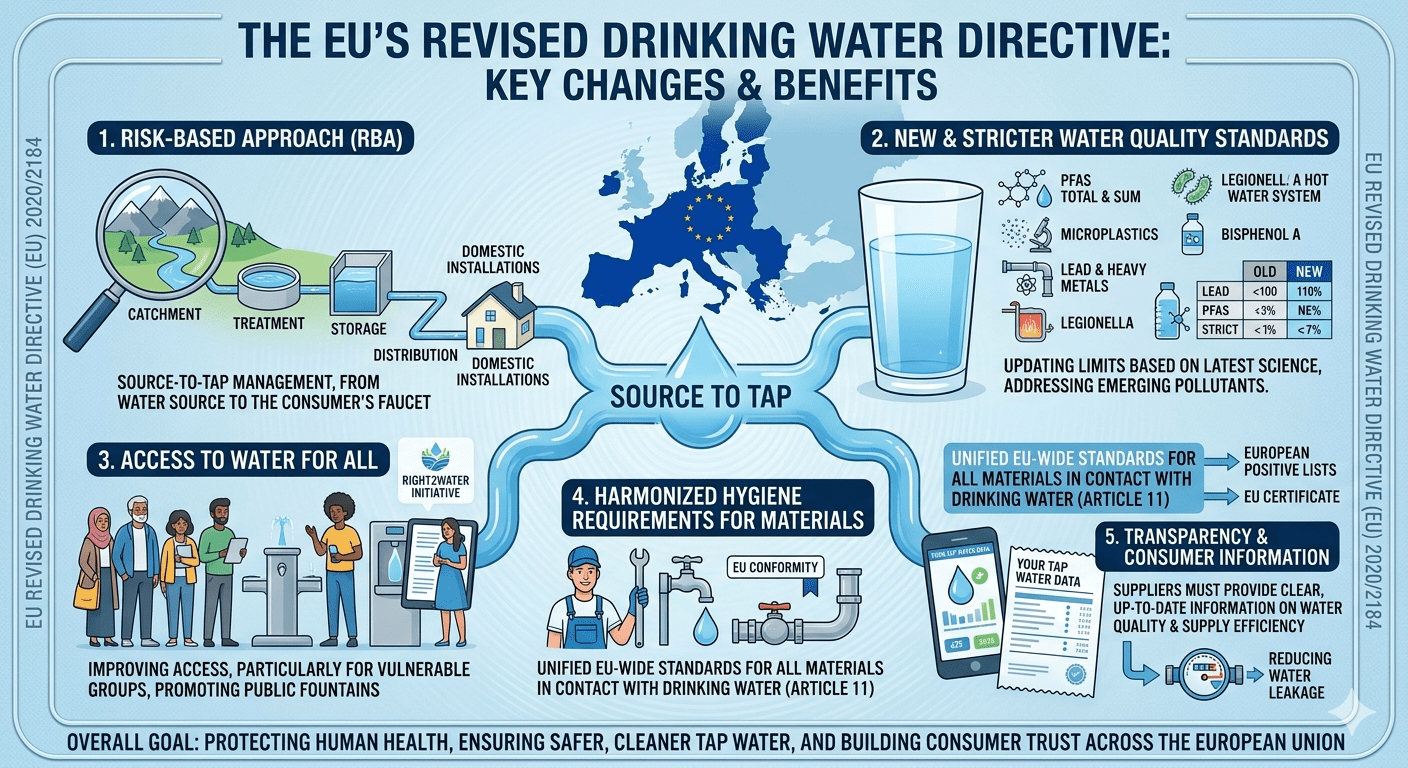
The recast directive introduces two new PFAS parameters that member states are now legally required to monitor and comply with. The first is “Sum of PFAS,” defined as the sum of 20 specific PFAS compounds listed in the directive’s annexes — including some of the most studied and most hazardous, such as PFOS, PFOA, and PFHxS. The maximum permitted concentration for this parameter is 0.1 micrograms per litre. The second parameter, “PFAS Total,” captures the totality of per- and polyfluoroalkyl substances measurable by proxy methods, with a limit of 0.5 micrograms per litre.
These limits are not advisory. Where they are exceeded, member states are required to take action — closing contaminated sources, adding treatment steps, or restricting use of the affected supply — and to inform the public. The European Commission has also published technical guidelines specifying the analytical methods recommended for compliance testing, based on the EN 17892 standard.
By the standards of PFAS science, the EU limits are meaningful. They are considerably more stringent than the initial 70 parts-per-trillion advisory the US Environmental Protection Agency issued in 2016, though some individual EU member states had already enacted stricter national rules ahead of the directive coming into force. Denmark set a limit of 2 parts per trillion for a subset of four PFAS; Sweden 4 parts per trillion; Germany has committed to 20 parts per trillion by 2028. The UK, outside the EU, set a 100 parts-per-trillion limit covering 47 PFAS compounds.
What the directive says about microplastics
The picture for microplastics is less settled — but moving. The recast directive identifies microplastics as an emerging pollutant of concern and provides for their monitoring. In May 2024, the European Commission adopted a Delegated Decision establishing a harmonised EU methodology for measuring microplastics in drinking water. Before this, member states had used widely varying methods, making it almost impossible to compare results across borders.
The harmonised methodology is the foundation for the next step: adding microplastics to the directive’s official watch list of substances of concern. Once that happens — and the Commission has indicated it intends to do so — water suppliers will be required to monitor concentrations and take action if a guidance value is exceeded. As of early 2026, a specific limit value for microplastics in drinking water has not yet been set. The science of what constitutes a safe level remains genuinely unresolved.
What it covers beyond the tap
The directive applies broadly: not only to water supplied through distribution networks, but also to water delivered by tanker, water in bottles and containers, and water used in food businesses for manufacturing, processing, or preserving food intended for human consumption. This is a wider scope than many people realise and reflects the reality that PFAS and microplastics enter food chains through multiple pathways, not just drinking directly from a tap.
The revised Urban Wastewater Treatment Directive, adopted in 2024, adds a further layer. It requires authorities to monitor PFAS levels in treated wastewater discharged into drinking water catchment areas — using the same parameters as the Drinking Water Directive — and to monitor microplastics at the inlets and outlets of larger treatment plants. This matters because wastewater treatment facilities have historically been a major route through which both contaminants enter freshwater systems.
A broader push on PFAS across the EU
The drinking water limits sit within a wider regulatory movement against PFAS across Europe. Five member states — the Netherlands, Germany, Sweden, Norway, and Denmark — have submitted a proposal to ECHA to restrict the manufacture and importation of approximately 10,000 PFAS substances under REACH regulation. This would be the most sweeping chemical restriction ever attempted in the EU, replacing the slow, compound-by-compound approach that allowed PFAS to proliferate in the first place.
The REACH restriction process is lengthy and its outcome is not yet determined. But the direction of travel is clear: European regulators are moving from managing individual PFAS chemicals to treating the entire class as a category of concern.
What is still missing
The directive is a significant step, but it has limits. The watch list mechanism — which covers substances whose risks are not yet fully assessed — currently contains only two substances: the endocrine disruptors 17-beta-estradiol and nonylphenol. Microplastics are not yet on it. The Commission’s monitoring framework does not yet require water suppliers to test for the full range of PFAS compounds beyond the 20 listed in the Sum of PFAS parameter. Short-chain PFAS, which are increasingly used as substitutes for banned long-chain compounds and which are highly mobile in water systems, may not be captured.
There is also the question of how uniformly the directive will be enforced. Transposing EU directives into national law is the responsibility of individual member states, and there is significant variation across Europe in the capacity and willingness of water regulators to act.
The Commission has described the recast directive as delivering “world-leading standards” for drinking water. That claim is debatable — particularly on PFAS, where some member states already apply stricter limits than the directive requires. What is harder to dispute is that binding rules now exist where none did before. For the millions of Europeans whose tap water has quietly contained PFAS for years, that is a change that matters.