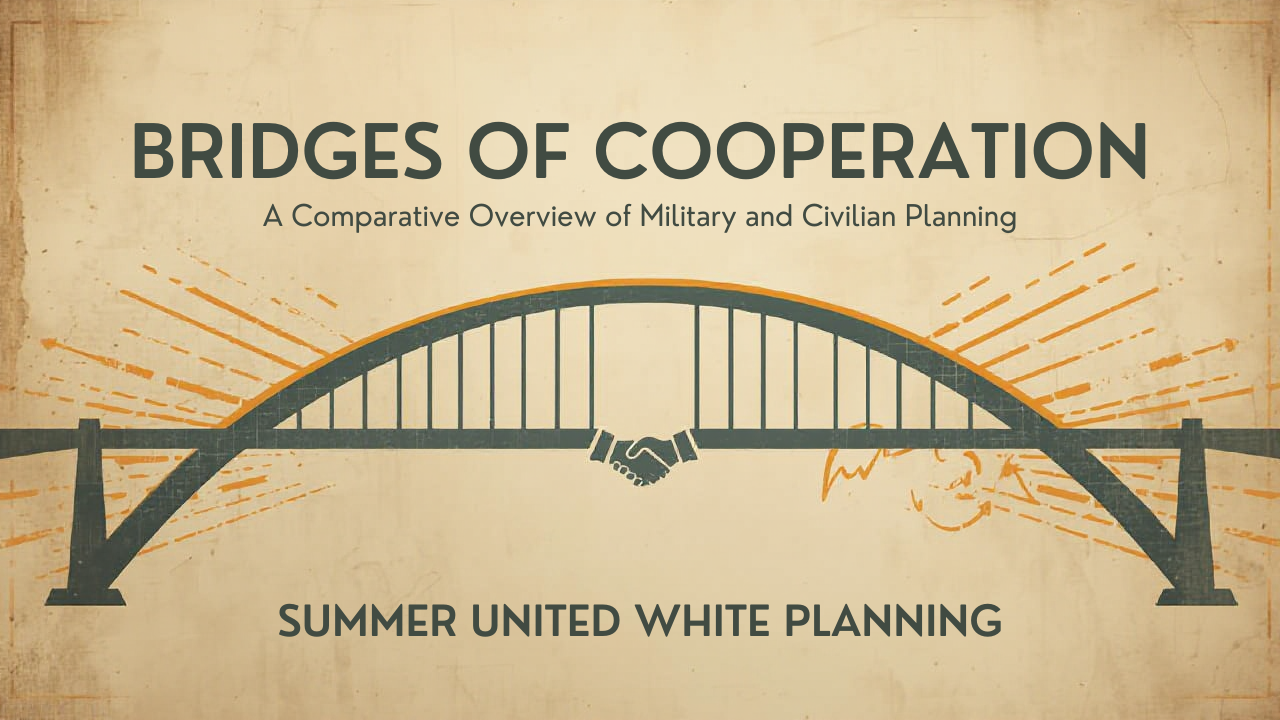
Explore the critical differences and synergies between USAID and DoD planning. This comparative overview covers military hierarchy, civilian development strategies, funding mechanisms like CERP, and the "Whole-of-Government" approach to international stability.
In modern geopolitical arenas, the boundary between “security” and “development” is virtually non-existent. For practitioners on the ground, the challenge isn’t just delivering aid; it’s executing “opposed development”—building schools and clinics while navigating the threat of violence.
To succeed, the U.S. Government utilizes a Whole-of-Government approach, primarily synchronized through USAID’s Office of Military Affairs (OMA). Understanding the “operational DNA” of both the civilian and military sectors is the first step toward effective stabilization.
1. Cultural DNA: Top-Down Command vs. Bottom-Up Sustainability
The friction between USAID and the Department of Defense (DoD) usually stems from their fundamental starting points.
| Feature | USAID (Civilian) | Department of Defense (Military) |
| Planning Direction | Bottom-up: Driven by local host-country realities. | Top-down: Driven by national security directives. |
| Primary Driver | Analysis: Long-term research and assessments. | Commander’s Intent: Specific mission objectives. |
| Timeline | Sustained: Multi-year capacity building. | Expedient: Time-bound “shaping” operations. |
| Implementation | Partners: NGOs and host-country institutions. | Personnel: Direct execution by US/Allied troops. |
| Locus of Power | In-Country: The Mission Director. | Regional: Combatant Commands (e.g., CENTCOM). |
Expert Insight: While the military focuses on “shaping the battlefield” for immediate stability, USAID focuses on “building the state” for long-term peace. One provides the breathing room; the other provides the foundation.
2. The Military Pillar: The Speed of Command
Military planning is codified in the Universal Joint Task List (UJTL). It is a culture of “mission accomplished” that values speed and hierarchy above all else.
-
GEF (Guidance for the Employment of the Force): The strategic “north star” issued every two years by the Pentagon.
-
TCP (Theater Campaign Plan): The regional strategy. This is the closest military equivalent to a civilian regional strategy.
-
Commander’s Intent: A concise expression of the purpose of the operation and the desired end-state.
3. The Development Pillar: The Reality of Results
In contrast, USAID planning is collaborative and analytical. In development, the process is often as important as the result. If a local community doesn’t “own” a project, it will likely fail once international forces leave.
The USAID Planning Hierarchy:
-
Mission Strategic Plan (MSP): High-level diplomatic and assistance priorities.
-
Assistance Objective (AO): Long-term support for specific sectors (e.g., health, rule of law).
-
Project Planning: The granular technical and financial design of specific activities.
4. Synergy in Action: Provincial Reconstruction Teams (PRTs)
PRTs are the ultimate “laboratory” for civilian-military integration. They operate in semi-permissive environments where combat has cooled but security is still fragile.
-
Military: Handles the “shield” (security, logistics, and force protection).
-
USAID: Handles the “seed” (reconstruction and capacity building).
-
State Dept: Handles the “bridge” (political oversight and diplomatic reporting).
5. The “Color of Money”: Funding the Mission
In joint environments, your authority is often defined by the “flavor” of your funding.
-
CERP (Commander’s Emergency Response Program): Highly flexible funds for urgent humanitarian needs. It is designed to “win hearts and minds” quickly by injecting cash into local economies.
-
OHDACA: Managed by the Defense Security Cooperation Agency (DSCA) for disaster relief and “excess property” transfers (e.g., medical supplies).
-
Complex Crises Fund: The civilian-led alternative for rapid response to emerging instabilities.
6. Closing the Gap: Rank Equivalency
For civilians, navigating the military “backbone” is easier when you understand the hierarchy. While not official, the following equivalencies are standard for operational coordination:
| Civilian Grade (GS/FS) | Military Rank (Approximate) |
| GS-12 / FS-3 | O-4 (Major / Lt. Commander) |
| GS-13/14 / FS-2 | O-5 (Lt. Colonel / Commander) |
| GS-15 / FS-1 | O-6 (Colonel / Captain) |
| SES / SFS | O-7 to O-10 (Generals / Admirals) |
Summary: The Integrated Future
A successful Whole-of-Government approach requires more than just sharing space; it requires a common language. By bridging the gap between “shaping” and “building,” the U.S. can ensure that the gains made by the military are sustained by civilian development.
3 Pro-Tips for Interagency Success:
-
Participate in TSCP Meetings: Align your Mission Strategic Plan with the military’s Theater Security Cooperation Plan early.
-
Use TCAPF: Utilize the Tactical Conflict Assessment and Programming Framework to ensure your goals aren’t working at cross-purposes.
-
Share the Map: Use the Development Experience Clearinghouse (DEC) to document activities, preventing the military from duplicating work you’ve already completed.