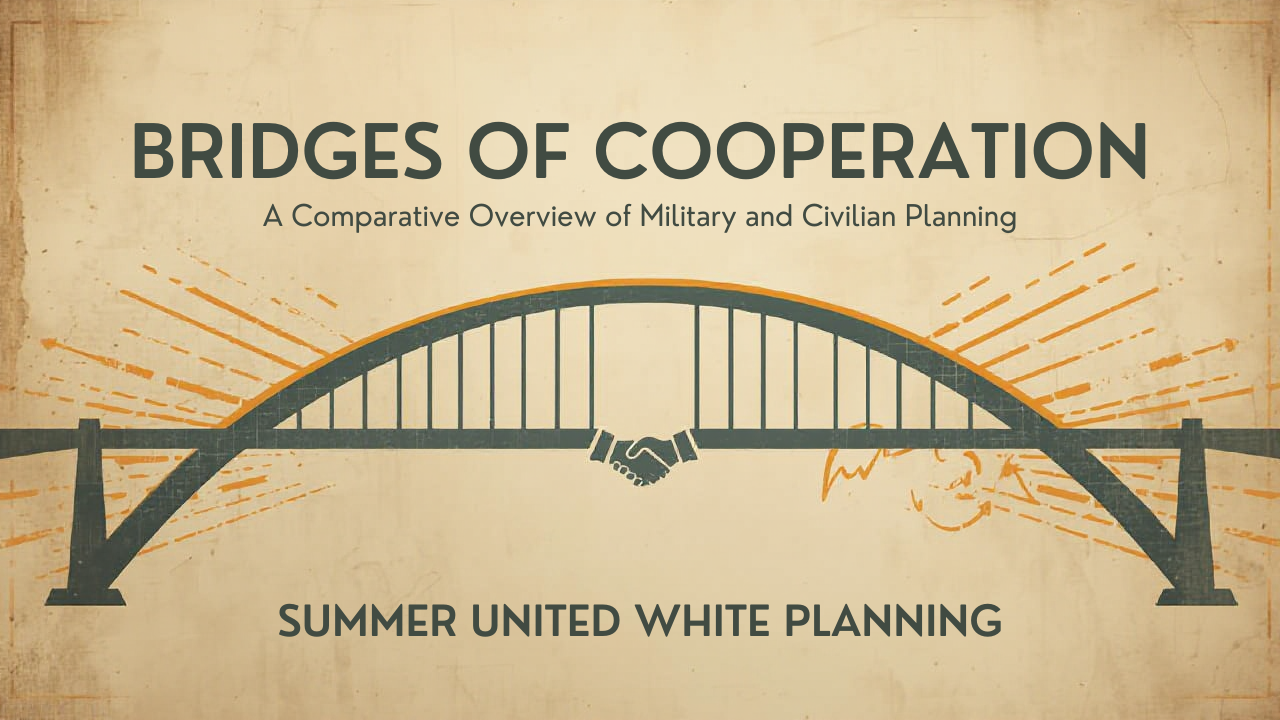
Bridges of Cooperation: A Comparative Overview of Military and Civilian Planning
Explore the critical differences and synergies between USAID and DoD planning. This comparative overview covers military hierarchy, civilian development strategies, funding mechanisms like CERP, and the "Whole-of-Government" approach to international stability.
1. The Core Conflict: Two Worlds, One Mission
In modern international relations, the lines between security and development often blur. When a country is unstable or experiencing “fragile” statehood, providing aid is no longer a simple matter of building infrastructure; it becomes a complex operation carried out under the threat of violence. This environment requires a coordinated U.S. Government approach to ensure that diplomatic, security, and military efforts are mutually reinforcing. The central tension is driven by the necessity of “development under instability,” a concept that requires civilian agencies to integrate their assets with the Departments of State, Defense, Treasury, and Justice.
As defined in the Civilian-Military Operations Guide:
“Humanitarian workers call it stability programming, civilian-military programming, conflict programming, or in some cases, opposed development. Military planners may call it SSTR (Stability, Security, Transition, and Reconstruction), Phase 0, or a number of other terms.”
To navigate this tension, the Office of Military Affairs (OMA) serves as the primary focal point for USAID’s interaction with the Department of Defense. OMA facilitates the coordinated planning, training, and exercises necessary to bridge these disparate cultures. Understanding these differences begins with a high-level comparison of their operational DNA.
2. The Great Divide: Top-Down vs. Bottom-Up
While USAID and the Department of Defense (DoD) often operate in the same geographic space, their organizational cultures are fundamentally distinct. These differences are rooted in their respective views on authority, resource allocation, and the ultimate objective of their presence.
Feature | USAID (Civilian) | Military (Defense) |
Planning Direction | Bottom-up: Planning starts with the reality on the ground in the host country. | Top-down: Planning is driven by high-level strategic directives and national security goals. |
Basis of Action | Analysis: Decisions are based on long-term development research and assessments. | Commander’s Intent: Actions are driven by specific goals set by a commanding officer to achieve a mission. |
Resource Constraints | Constrained: Operates with limited, strictly earmarked budgets and personnel. | Not constrained: Generally possesses significantly larger resource pools and logistical reach. |
Engagement Type | Sustained: Focuses on long-term, multi-year capacity building and sustainability. | Mission-oriented: Focuses on specific, time-bound objectives and immediate effects. |
Implementation | Partners: Work is performed by host-country institutions, NGOs, and contractors to build capability. | Personnel: Work is performed by US/Allied personnel to “shape the battlefield” and execute mission-derived tasks (UJTL). |
Locus of Power | In-country: Decision-making power usually resides with the Mission Director in-country. | Combatant Command: Power resides at regional headquarters (UCCs) like CENTCOM or AFRICOM. |
A critical distinction for any practitioner is that while USAID’s overarching goal is strengthening host-country capability, such sustainability is generally not a primary consideration in the military realm. These structural differences are not just bureaucratic but are rooted in the specific planning hierarchies of each organization.
3. The Military Pillar: Planning by Command and Intent
Military planning is a highly formalized, sophisticated discipline grounded in a history of preparation for combat. This heritage creates a culture that values speed, clear hierarchies, and a “mission accomplished” mindset.
The “So What?” for Civilians: For a civilian, the military’s speed can be staggering, but their focus is often on immediate “battlefield shaping” effects rather than long-term development. Because military planning is designed to respond to threats, it prioritizes the Commander’s Intent—a clear statement of the desired end-state. Civilians must understand that military actions are codified in the Universal Joint Task List (UJTL), a menu of capabilities used to accomplish assigned missions.
The military planning hierarchy is defined by several key levels:
- GEF (Guidance for the Employment of the Force): The Pentagon’s highest strategic guidance, issued every two years to provide operational priorities.
- TCP (Theater Campaign Plan): The regional strategy created by a Combatant Command that serves as the document most closely corresponding to a civilian regional strategy.
- Country Plans: Specific engagement plans for a single nation, derived from the Theater Security Cooperation Plan (TSCP), which outlines the formal peacetime engagement process.
This command-driven approach ensures that every unit knows its objective, contrasting sharply with the USAID method of building from the ground up.
4. The Development Pillar: Planning by Reality and Results
USAID planning is a collaborative, analytical process that derives from the “reality on the ground.” Its primary goal is to build the capacity of the host country’s government and civil society so they can eventually sustain themselves without foreign intervention.
The “So What?” for Civilians: In development, the process of implementation is as important as the result. By working through local partners, USAID ensures that host-country stakeholders have a “buy-in” to the outcome. This creates sustainable stability that persists long after a military unit has redeployed.
USAID planning is structured into three primary elements:
- Strategic Planning: Formulated in coordination with the Department of State, this manifests in the Mission Strategic Plan (MSP) or the Operational Plan (OP), defining broad diplomatic and assistance priorities.
- Assistance Objective (AO) Planning: Designing long-term support for clearly defined foreign assistance results, such as healthcare or economic growth.
- Project Planning: The detailed design of activities, including technical feasibility, financial planning, and procurement considerations.
While these methodologies differ, specific “joint” structures exist to force them together in the field.
5. Synergy in the Field: Provincial Reconstruction Teams (PRTs)
The primary model for civilian-military integration is the Provincial Reconstruction Team (PRT). These interim units operate in “semi-permissive” environments where hostilities have ceased but physical insecurity remains high.
In a PRT, roles are distributed by agency expertise:
- Military: Responsible for security, force protection, and logistics for all PRT members.
- USAID: Leads reconstruction, development efforts, and host-country capacity building.
- State Department: Provides political oversight, coordination, and reporting.
Key Skill Sets for PRT Success: To thrive in an integrated PRT, personnel must master specific competencies beyond their parent agency’s training:
- Communication: Clearly translating goals across civilian and military lexicons.
- Negotiation: Balancing commander requirements with the needs of local leaders.
- Tactical Awareness: Understanding security risks and force protection protocols.
- Understanding Roles of NGOs/International Organizations: Navigating the complex humanitarian landscape to avoid friction.
- Teamwork: Building “interagency camaraderie” prior to and during deployment.
Beyond physical structures like PRTs, coordination is often driven by the “color of money” or specific funding streams.
6. The Engine of Action: Comparing Funding Mechanisms
Understanding joint operations requires navigating the various funding sources that support stability operations. These funds have different rules, authorities, and “flavors.”
- CERP (Commander’s Emergency Response Program)
- Primary Purpose: Provides commanders in Iraq and Afghanistan with funds for urgent humanitarian and reconstruction needs (e.g., water repair, civic cleanup).
- The “So What?”: CERP allows “battlefield shaping” through immediate relief. It is highly flexible—with many Federal Acquisition Regulation (FAR) provisions waived—to inject money into local economies and “win hearts and minds.”
- Section 1207 (Historical Transition)
- Primary Purpose: Originally allowed the Secretary of Defense to transfer funds to the State Department for reconstruction and stabilization.
- The “So What?”: It was designed to put civilian professionals alongside warfighters. Note that as of FY 2010, Section 1207 was being limited and phased out in favor of the Complex Crises Fund.
- OHDACA (Overseas Humanitarian, Disaster, and Civic Aid)
- Primary Purpose: Managed by the Defense Security Cooperation Agency (DSCA), it is used for humanitarian assistance, disaster relief, and mine action.
- The “So What?”: These funds are often used to transport “excess non-lethal property” and build goodwill through medical clinics or school repairs, but projects must not duplicate the work of other USG agencies.
Navigating these funds requires a clear understanding of the institutional “backbone” of the military.
7. Understanding the Military “Backbone”: Ranks and Culture
For civilians, the military hierarchy is the scaffolding of all operations. It is divided into three distinct tiers:
- Commissioned Officers (O-1 to O-10): The generalists and decision-makers who hold presidential commissions.
- Warrant Officers: Highly specialized experts in specific technologies or capabilities. They sit between NCOs and Commissioned Officers, acting as technical leaders.
- Non-Commissioned Officers (NCOs): The “backbone” of the military. They are the primary leaders responsible for training troops and executing the mission on the ground.
To facilitate coordination, civilians should recognize the rough equivalence between GS/FS grades and military ranks:
Civilian Grade (GS/FS) | Military Rank |
GS-12 / FS-3 | O-4 (Major / Lt. Commander) |
GS-13/14 / FS-2 | O-5 (Lt. Colonel / Commander) |
GS-15 / FS-1 | O-6 (Colonel / Captain) |
SES / SFS | O-7 to O-10 (Generals / Admirals) |
Military activity is overseen by Unified Combatant Commands (UCCs), which are large regional or functional headquarters (e.g., AFRICOM, PACOM).
8. Conclusion: The Integrated Future
The goal of civilian-military cooperation is a “Whole-of-Government” approach. In this model, “soft power” (development) and “hard power” (defense) are mutually reinforcing. While their cultures differ, their integration is essential for ensuring stability in the world’s most unstable regions.
Summary of Final Takeaways
- Military planning is hierarchical, mission-driven, and focused on immediate effects.
- Civilian planning is analytical, partner-driven, and focused on long-term sustainability.
- Successful coordination requires bridging the gap between “shaping the battlefield” and “building capacity.”
3 Tips for the Aspiring Coordinator:
- Undertake Joint Conflict Assessments: Use tools like the Tactical Conflict Assessment and Programming Framework (TCAPF) to ensure security and development goals are aligned from the start.
- Attend TSCP Meetings: Actively participate in Theater Security Cooperation Plan meetings at the Combatant Command to align your Mission Strategic Plan with regional military goals.
- Map and Document Activities: Use resources like the Development Experience Clearinghouse (DEC) and Developedia to map your activities. Sharing these “lessons learned” with military counterparts avoids duplication of effort and clarifies the civilian footprint for the commander.