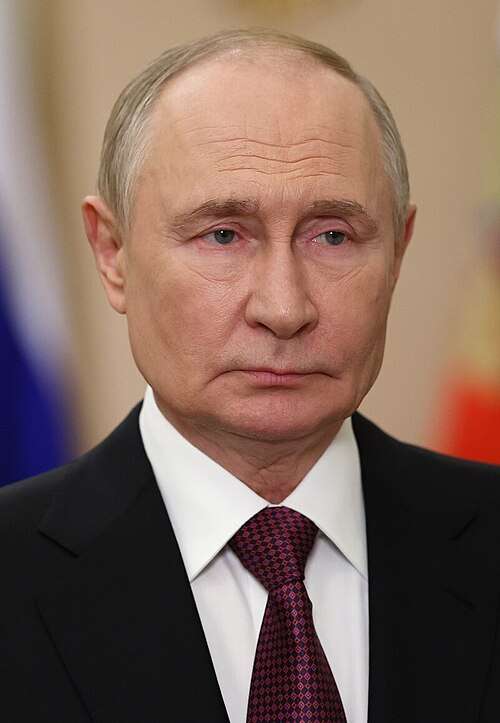
Vladimir Putin
Vladimir Vladimirovich Putin (born 7 October 1952) is a Russian politician and former intelligence officer who has served as the President of Russia since 2012, and previously from 2000 to 2008. He also served as the Prime Minister from 1999 to 2000 and again from 2008 to 2012. As of March 2026, Putin is in the second year of his fifth presidential term, following a 2024 election that extended his potential rule until 2036.
Early Life and KGB Career
Putin was born in Leningrad (now Saint Petersburg) and studied law at Leningrad State University, graduating in 1975. He served 16 years as a KGB foreign intelligence officer, rising to the rank of lieutenant colonel before resigning in 1991 to begin a political career in Saint Petersburg. He moved to Moscow in 1996, joining the administration of President Boris Yeltsin, where he quickly rose to become Director of the Federal Security Service (FSB) and later Prime Minister.
Presidency and Governance
Putin’s tenure has been defined by the centralization of state power, a concept often referred to as the “Vertical of Power.” His early terms were marked by significant economic growth driven by high oil prices, which helped stabilize the country following the post-Soviet collapse of the 1990s.
Fifth Term and 2026 Priorities
In early 2026, the Putin administration has pivoted toward “structural transformation” to address the long-term impacts of international sanctions and the Russo-Ukrainian War. His current strategic tasks include:
- Demographic Reversal: Addressing a declining birth rate through expanded family subsidies.
- Technological Sovereignty: Prioritizing domestic AI, autonomous systems, and digital platforms to replace Western technology.
- Wartime Economy: As of 2026, nearly 29% of the federal budget is earmarked for national defense, with a significant increase in VAT (to 22%) implemented to sustain military spending.
Foreign Policy and Conflicts
Putin’s foreign policy is characterized by a pursuit of “multipolarity” and the restoration of Russia as a global Great Power.
- Ukraine: The 2022 full-scale invasion remains the defining conflict of his legacy. By March 2026, the war has entered its fifth year, with the Kremlin focusing on “hybrid escalation” to undermine European support for Kyiv.
- Eastern Pivot: Under Putin, Russia has significantly deepened its “no limits” partnership with China and expanded military-technical cooperation with Iran and North Korea.
Domestic Status and Continuity
Following the 2020 constitutional amendments, Putin effectively reset his term limits. Domestically, his administration has significantly curtailed political opposition, categorized by the 2024 death of Alexei Navalny and the subsequent suppression of “non-systemic” movements. Public approval remains high in official polling, though independent analysts note a growing “war fatigue” and concern over inflation, which remains above 12% in early 2026.
Personal Profile
| Office | President of the Russian Federation |
| Assumed Office | 7 May 2012 (Current Term: May 2024) |
| Political Party | Independent (Supported by United Russia) |
| Education | Leningrad State University (LLB) |
| Military Rank | Colonel (Retired), KGB |