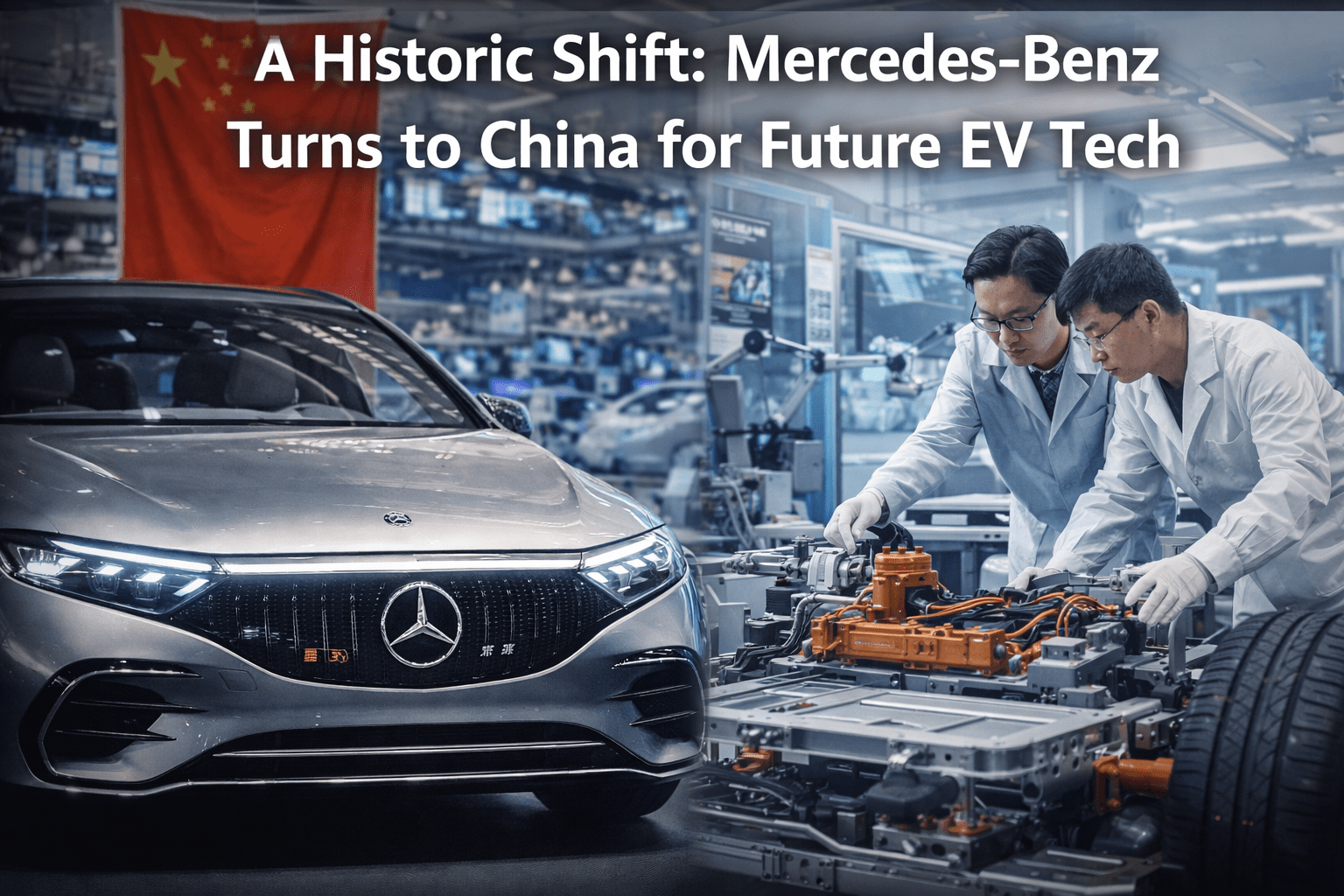
Mercedes-Benz is reportedly developing a new electric vehicle platform codenamed “Phoenix” using Geely’s GEA electronic architecture — potentially shifting lead development responsibility to its Chinese R&D centre for the first time in the company’s history. The move reflects a broader realignment in who holds the technology advantage in electric vehicles.
Reporting based on Chinese automotive industry sources, Mercedes-Benz investor communications, and automotive technology analysis from Schmidt Automotive Research and Bernstein Research · Updated March 2026
For most of the past century, the direction of automotive technology transfer has been largely one-way: German engineering expertise, developed in Stuttgart and Munich, exported to the rest of the world. The possibility that Mercedes-Benz — the company that built the first petrol-powered automobile in 1885 — may adopt Chinese electronic architecture for its next generation of entry-level electric vehicles represents a genuine inversion of that dynamic.
According to reports originating from Chinese automotive industry sources and subsequently covered by Automotive News Europe and Car and Driver, Mercedes is developing a new EV platform internally designated “Phoenix.” The platform is intended to underpin successors to the current A-Class, CLA, GLA, and GLB — Mercedes’ volume entry-level models — with series production targeted for around 2030. The reported centrepiece of the Phoenix architecture is the adoption of Geely’s GEA (Geely Electronic Architecture) for the vehicle’s electronic and software systems, with Mercedes’ Chinese R&D centre potentially taking lead development responsibility for the entire platform.
Mercedes-Benz has not made a formal public announcement confirming the Phoenix programme’s details. The company’s standard position on unreported future product developments is neither confirmation nor denial, and investor relations materials as of Q1 2026 do not reference Phoenix by name. What Mercedes has confirmed publicly is a strategic review of its entry-level vehicle portfolio, a commitment to significant cost reduction in its electric vehicle development programmes, and an acknowledgment that Chinese technology partners represent a credible source of competitive capability in specific domains.
What GEA Actually Is — and Why It Matters
The Geely Electronic Architecture is not a powertrain or a battery system — it is the electronic nervous system that governs how a modern vehicle’s computing hardware and software components communicate with each other. In contemporary vehicles, this encompasses an increasingly large and complex set of functions: infotainment and connectivity, over-the-air software update capability, advanced driver assistance systems (ADAS), battery management, thermal management, and the integration between these systems that determines how the vehicle behaves as a whole.
In traditional vehicle development, each of these functions was managed by separate electronic control units (ECUs) supplied by different Tier 1 suppliers — Bosch, Continental, Denso — with proprietary communication protocols that were notoriously difficult to update, integrate, or adapt. A typical premium vehicle from the mid-2010s might contain 70–100 separate ECUs, each running its own software stack, connected by a wiring harness that could weigh 50–60 kilograms.
The shift to centralised compute architectures — fewer, more powerful domain controllers or central vehicle computers managing multiple functions — is where Chinese EV manufacturers have moved fastest. BYD, NIO, Xpeng, and Li Auto all developed their electronic architectures from scratch for the electric vehicle era, without the legacy ECU infrastructure that incumbent manufacturers needed to maintain compatibility with. Geely’s GEA 4.0, the version Mercedes is reportedly evaluating, is designed around this centralised architecture: fewer ECUs, standardised communication protocols, and a software layer that enables over-the-air updates across the full vehicle system rather than function-by-function.
The practical benefits Mercedes is reportedly seeking are reduced development cost, faster software iteration cycles, and — critically — easier maintenance and repair in the field. A vehicle architecture that can be diagnosed and updated remotely, and whose components follow standardised interfaces rather than proprietary ones, has materially lower lifetime service costs than the fragmented ECU architectures of previous generations. At the entry-level price points of the A-Class successor, where margin pressure is most acute, this cost reduction matters more than at the S-Class level where engineering cost is a smaller fraction of transaction price.
The Geely Relationship: More Than a Supplier Transaction
The Geely connection in this context is not a simple supplier relationship, and understanding it requires some background on Geely Holding Group’s position in the global automotive landscape.
Geely is the Chinese private automotive conglomerate that owns Volvo Cars, Polestar, Lotus, and Lynk & Co, among other brands. It is also the single largest shareholder in Mercedes-Benz Group AG, having acquired approximately 9.7% of the then-Daimler AG in 2018 through a series of market purchases — a stake that Geely founder Li Shufu described at the time as a long-term strategic investment. Mercedes-Benz and Geely also have an existing joint venture in China — smart Automobile — which develops and manufactures the relaunched Smart brand’s electric vehicles, with Geely handling much of the development work.
The Phoenix platform, if it uses GEA architecture, would therefore not represent Mercedes doing business with a new or unknown partner but deepening an existing relationship with its largest shareholder and an established joint venture partner. From a corporate governance perspective, the arrangement has a different character than it would if Mercedes were approaching, say, CATL or Huawei as an entirely external technology supplier — though it also raises questions about the alignment of interests between Geely as shareholder and Geely as technology supplier that Mercedes’ supervisory board would need to address.
Mercedes-Benz’s current CEO Ola Källenius has spoken publicly about the need to reduce the cost base of Mercedes’ entry-level electric vehicle programme without compromising on the quality standards that differentiate the Mercedes brand from volume competitors. The GEA adoption, if confirmed, would represent one specific answer to that challenge — accepting that in electronic architecture, a Chinese partner has built something better and cheaper than Mercedes could develop in-house on the timeline and budget available.
The R&D Power Shift: What Lead Development in China Would Mean
The potential shift of lead development responsibility for the Phoenix platform to Mercedes’ Chinese R&D centre — rather than the traditional hub at the Mercedes-Benz Technology Center in Sindelfingen and the main Stuttgart engineering campus — is arguably the more structurally significant element of this story than the GEA architecture choice itself.
Mercedes employs approximately 15,000 R&D staff in Germany, concentrated in Baden-Württemberg. Its Chinese R&D operations, based primarily in Beijing and with a significant presence in Shanghai, are substantially smaller but have been growing as the company recognised that developing vehicles specifically for the Chinese market — China accounts for approximately 35% of Mercedes’ global sales — requires engineering talent that understands Chinese consumer preferences and Chinese regulatory requirements from the ground up.
Lead development responsibility for a major global platform — as opposed to China-specific adaptations of German-developed platforms — would represent a fundamental change in the organisational structure of Mercedes’ engineering function. It would mean that the critical decisions about the Phoenix platform’s technical architecture, software strategy, supplier relationships, and development priorities would be made by engineers based in China, with German engineering centres playing a supporting rather than directing role.
The precedent this would set is significant beyond Mercedes itself. No German premium automotive manufacturer has previously ceded lead platform development to a non-German centre. Volkswagen’s partnership with Xpeng — announced in 2023, involving a €700 million investment for a 4.99% stake and a joint platform development agreement — similarly involves significant Chinese engineering contribution, but VW has characterised it as a collaboration rather than a transfer of lead responsibility.
The IG Metall trade union, which represents Mercedes’ German engineering workforce and holds supervisory board seats under Germany’s co-determination law, has not publicly commented on the Phoenix reports specifically, but has been consistent in its position that core development work should remain in Germany. Any formal announcement of a lead development shift to China would likely trigger significant union engagement with the Mercedes supervisory board.
The Broader Pattern: Western Automakers and Chinese Technology
Mercedes is not making this move in isolation. The past three years have seen a sustained pattern of Western automotive manufacturers acknowledging that Chinese EV technology — particularly in software architecture, battery management, and driver assistance systems — has moved from follower to leader status in specific domains.
Volkswagen and Xpeng. Volkswagen’s 2023 investment in Xpeng gave VW access to Xpeng’s SEPA 2.0 electronic architecture and XNGP driver assistance technology, which VW is adapting for its China-specific Volkswagen-branded models. The deal was framed explicitly as a technology acquisition: VW needed capabilities it could not develop on its own timeline for the Chinese market.
Stellantis and Leapmotor. Stellantis’ €1.5 billion investment for a 21% stake in Leapmotor, completed in 2023, went further than a technology licensing arrangement — it created a joint venture to manufacture and sell Leapmotor vehicles outside China. Stellantis gains access to Leapmotor’s integrated EV architecture (developed around a central domain controller approach) and its competitively priced battery and powertrain systems.
BMW and CATL. While not an architecture partnership, BMW’s deep supply relationship with CATL — including cell chemistry co-development for the Neue Klasse platform — represents a similar acknowledgment that in battery technology specifically, Chinese suppliers have reached or exceeded Western capability.
The common thread is not desperation but calculation: Chinese EV manufacturers, unencumbered by legacy ICE development costs and benefiting from substantial state support for EV infrastructure and supply chain development, moved faster on the software and electronics side of the EV transition. Western manufacturers that spent 2015–2020 developing their own in-house architectures — Volkswagen’s MEB platform, Mercedes’ own EVA2, Stellantis’ STLA — are now evaluating whether those investments are sufficient or whether partnership with faster-moving Chinese technology companies is more cost-effective.
The Competitive Implications for the Entry-Level Premium Segment
The specific models that Phoenix would underpin — A-Class, CLA, GLA, GLB successors — compete in what is simultaneously the highest-volume and most price-sensitive segment of the premium market. These are the models that bring younger buyers into the Mercedes brand and generate the volume that supports the company’s fixed cost base.
In the electric transition, this segment faces a specific challenge: at price points of €35,000–55,000, the battery cost as a fraction of total vehicle cost is higher than in larger, more expensive models, and the margin available to absorb premium engineering development costs is lower. BMW’s i1 and Audi’s A2 equivalent programmes face the same structural economics.
Genesis — Hyundai’s luxury arm, which is launching three new models in the Netherlands in spring 2026 as part of a direct offensive against the German premium brands — is competing in exactly this segment with vehicles developed on the Hyundai Motor Group’s E-GMP platform, which benefits from Hyundai’s integrated approach to EV development and significantly lower development cost per model relative to the German brands. Genesis is pricing its models to undercut comparable German competitors by €5,000–8,000 while matching or exceeding them on technology specifications — a combination that would be difficult to sustain without structural cost advantages in the development and manufacturing process.
If Phoenix and GEA deliver the cost reductions Mercedes is reportedly targeting, they would help address the competitive gap that Genesis and Chinese brands beginning European market entries are exploiting. If the programme is delayed, descoped, or fails to meet Mercedes’ quality standards in evaluation — all possibilities at this early stage — the competitive position of Mercedes’ entry-level models in the early 2030s becomes more difficult.
In Brief: Other Automotive Developments — March 2026
EV lifecycle emissions study. A new lifecycle analysis published in Nature Energy finds a widening gap between the emissions credentials claimed in manufacturer communications and the actual lifecycle carbon footprint of EV models when accounting for electricity grid carbon intensity in the markets where they are sold and the full supply chain emissions of battery production. The study identifies Toyota as a significant laggard in the electrification transition among major global manufacturers — a finding consistent with Toyota’s own public strategy, which has prioritised hybrid technology and hydrogen fuel cell development over battery electric vehicles. Toyota’s response reiterated the company’s position that technology neutrality — supporting multiple low-emission powertrains rather than committing exclusively to BEV — better serves diverse global market conditions.
Genesis Netherlands offensive. Genesis is launching the GV70 electric, G80 electric, and GV80 Coupe in the Netherlands market simultaneously — a three-model offensive timed to coincide with the spring selling season and positioned explicitly to challenge Audi, BMW, and Mercedes in the mid-to-large premium segment. Genesis has been growing its European presence steadily since establishing direct sales operations in the Netherlands, Germany, and the UK, and its pricing strategy — undercutting comparable German models while matching them on technology and warranty coverage — has attracted consistent attention from automotive press and increasing interest from fleet buyers.
Suzuki Jimny “Big Brother” rumours. Automotive press including Auto Express and Autocar have reported renewed speculation about a larger Suzuki off-roader drawing on the Jimny’s aesthetic language, potentially slotting above the Jimny in Suzuki’s lineup at a size closer to the Mercedes G-Wagon’s footprint. Suzuki has not confirmed any such programme. The current Jimny — reintroduced to European markets in a commercial vehicle variant to comply with fleet CO₂ regulations — maintains a cult following that has sustained waiting lists at dealerships since relaunch, suggesting genuine consumer demand for a larger version if Suzuki chose to develop one.
Sources & Further Reading
- Mercedes-Benz Group AG — Investor relations and annual reports
- Geely Holding Group — GEA architecture and technology overview
- smart Automobile — Mercedes-Benz and Geely joint venture
- Automotive News Europe — Phoenix platform reporting
- Volkswagen Group and Xpeng — Partnership announcement
- Stellantis and Leapmotor — Strategic partnership documentation
- BMW Group and CATL — Battery supply and co-development
- Hyundai Motor Group — E-GMP electric platform
- Genesis Europe — Netherlands model launch
- Schmidt Automotive Research — Chinese EV technology competitive analysis
- IG Metall — German automotive workforce and co-determination
- Nature Energy — EV lifecycle emissions research