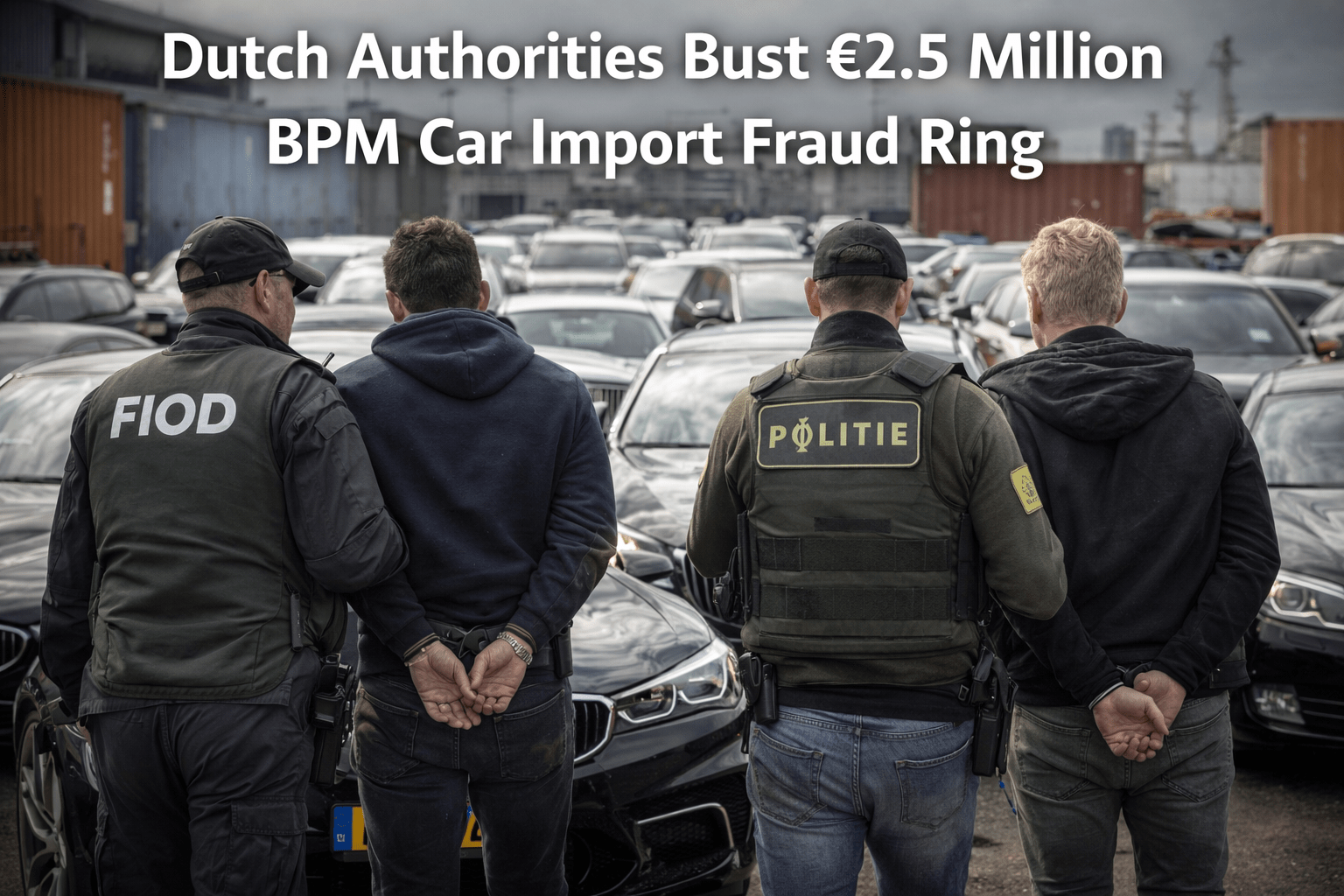
Seven suspects have been arrested by the FIOD following an investigation into a scheme that used falsified vehicle damage reports to reduce BPM tax payments by up to 90%. The case highlights a structural vulnerability in the Netherlands’ vehicle import valuation system — and leaves buyers of the affected cars facing potential legal and insurance exposure.
Reporting based on FIOD official press release, Dutch Tax Authority BPM documentation, and automotive market reporting · Updated March 2026
The Fiscal Information and Investigation Service (FIOD), the Dutch financial crimes investigation agency operating under the Tax and Customs Administration, has arrested seven people in connection with a tax fraud operation that is estimated to have cost the Dutch state approximately €2.5 million in unpaid vehicle import tax. The suspects — from Amsterdam, Purmerend, Den Bosch, Doetinchem, and Enschede — were released after questioning but remain under active investigation for fraud and document forgery.
The case centres on systematic manipulation of the BPM (belasting van personenauto’s en motorrijwielen — private motor vehicle and motorcycle tax), the Dutch import tax levied on passenger cars and motorcycles brought into the country. The mechanism used was precise: falsified technical valuation reports claiming severe vehicle damage that did not exist, reducing reported vehicle values by as much as 90% and proportionally reducing the BPM liability on each imported car.
How BPM Works — and How the Scheme Exploited It
BPM is a one-time tax assessed at the point a passenger vehicle is first registered in the Netherlands, whether purchased new from a Dutch dealer or imported from abroad. For new vehicles, BPM is calculated as a percentage of the vehicle’s list price, with rates that vary based on CO₂ emissions under the Netherlands’ environmental taxation framework.
For imported used vehicles — the category at the centre of this case — the calculation is different and, critically, more susceptible to manipulation. Used car BPM is based on the vehicle’s current market value rather than its original list price, with depreciation schedules applied to calculate what fraction of the original BPM liability remains due. The RDW (Netherlands Vehicle Authority) oversees vehicle registration, while the Tax Authority relies on submitted valuation reports to establish the basis for BPM assessment.
The system includes a legitimate provision for vehicles with abnormal damage: if a car has been in a significant accident or has other serious defects that reduce its market value below the standard depreciation schedule, a specialist valuation report can be submitted to claim a lower BPM assessment. This provision exists to avoid overtaxing genuinely damaged vehicles — and it is precisely this provision that the suspects allegedly exploited.
The scheme, as described by the FIOD, worked as follows:
Step 1 — Import selection. Vehicles were sourced, primarily from other EU member states where cars can be purchased and transported freely under single market rules.
Step 2 — False damage reports. Technical valuation reports were created — or caused to be created — claiming that each vehicle had sustained “abnormal damage” that did not reflect its actual condition. The FIOD’s investigation found that these reports reduced stated vehicle values by up to 90% relative to actual market value.
Step 3 — Reduced BPM payment. With the falsified valuations submitted to the Tax Authority, the BPM assessed on each vehicle was a fraction of the correct amount. The difference — between what was paid and what was owed — represents the alleged fraud, totalling approximately €2.5 million across the investigated transactions.
Step 4 — Market sale. The vehicles, now registered in the Netherlands with fraudulently low tax paid, were sold at or near actual market value — generating a margin that incorporated the tax saving.
Why This Is Harder to Detect Than It Sounds
The BPM damage valuation loophole has been a documented vulnerability in the Dutch vehicle import system for several years. The Dutch Tax Authority’s own guidance requires that damage valuation reports be produced by recognised specialists, but the recognition system for valuers has not historically been accompanied by systematic cross-checking of reported damage against independent vehicle condition data.
A vehicle imported from Germany or Belgium arrives with its own documentation history. If a fraudulent valuation report claims significant damage, verification requires either physical inspection of the vehicle at the point of import — which resource constraints make impractical at scale — or cross-referencing the report against the vehicle’s repair history, registration records in the country of origin, and photographic documentation. Each of these verification steps is individually feasible but collectively demanding enough that systematic fraud can persist across multiple transactions before patterns emerge.
The FIOD’s investigation is understood to have been triggered by analysis of BPM filing patterns across the import market — specifically the anomalous concentration of “abnormal damage” claims in filings associated with the suspected network. This kind of data-pattern detection, using the Tax Authority’s transaction records rather than physical vehicle inspection, is increasingly the primary tool for identifying organised tax fraud in vehicle markets across EU member states. The European Public Prosecutor’s Office (EPPO), which coordinates cross-border VAT and customs fraud investigations, has documented similar BPM and equivalent vehicle import tax schemes in Belgium, Germany, and Denmark — suggesting the Netherlands case is one instance of a pattern operating across the single market.
What Was Seized
During coordinated raids, FIOD officials seized:
- Bank accounts — both personal and business accounts associated with the suspects
- Vehicles — including vehicles believed to have been imported through the fraudulent scheme
- Real estate — property held by one or more suspects as assets potentially representing proceeds of the fraud
- Mobile phones and digital devices — for forensic examination of communications and transaction records
The asset seizures serve two distinct purposes: preserving potential evidence for prosecution, and securing assets against dissipation before any eventual confiscation order if the suspects are convicted. The Dutch Code of Criminal Procedure allows for pre-trial asset freezing on the authorisation of a judge-commissioner where there is reasonable suspicion of offences generating financial proceeds — a threshold the FIOD clearly satisfied in this case.
The suspects are being investigated under provisions of the Dutch Criminal Code covering fraud (Article 326) and document forgery (Article 225). Maximum sentences for these offences are four and six years respectively, with the possibility of significantly heavier sentences where charges are brought in combination or where organised crime aggravators apply.
The Risk to Buyers: Why This Affects More Than the Suspects
The FIOD’s public statement included an explicit warning directed not at fraudsters but at ordinary consumers — specifically, buyers who may have purchased one of the fraudulently imported vehicles in good faith and now hold a car whose legal status is compromised.
The core problem is that BPM is a registration tax: it is assessed and must be correctly paid before a vehicle can be legally registered in the Netherlands. If a vehicle was registered on the basis of a fraudulent valuation — meaning the correct BPM was never paid — the registration itself may be legally defective, and the outstanding BPM liability may ultimately fall on the current registered owner rather than the original importer.
The Tax Authority’s position on fraud-tainted registrations is that the tax debt follows the vehicle, not necessarily the party that originally incurred it — a rule designed to prevent fraudsters from insulating their proceeds by selling on quickly. In practice, good-faith purchasers who can demonstrate they had no knowledge of the fraud and paid a genuine market price typically have grounds to contest liability, but the process involves engagement with the Tax Authority and potentially protracted administrative proceedings.
The insurance dimension is separate but related. Dutch motor insurers base coverage and claims assessment on the assumption that a vehicle’s registration is legally valid. If an insurer discovers in the course of a claim that a vehicle was registered on the basis of fraudulent BPM documentation, it may contest the validity of the policy or the claim, depending on the specific policy terms and the circumstances of the discovery.
The FIOD’s advice to consumers who believe they may have purchased an affected vehicle is to contact the Tax Authority’s BPM desk proactively — establishing good faith early is materially better than waiting for a Tax Authority inquiry.
The Market Impact: Unfair Competition in the Import Trade
The FIOD’s characterisation of BPM fraud as creating “unfair competition in the automotive market” reflects a concern that extends beyond the immediate tax loss.
The Dutch used car import market is substantial: the Netherlands imports several hundred thousand used passenger vehicles annually, predominantly from Germany, Belgium, and other EU member states, for sale through both dealer networks and private channels. Legitimate importers — dealers who correctly assess, calculate, and pay BPM on their imports — compete on price with operators who are fraudulently understating their tax liability.
If a fraudulent operator can sell a vehicle at a price €3,000–5,000 below a legitimate competitor’s price (reflecting the avoided BPM on a mid-range imported car) while maintaining comparable margins, the competitive distortion is significant. BOVAG, the Dutch automotive retail trade association, has raised BPM fraud as a competitive concern in submissions to the Tax Authority on multiple occasions, noting that it disproportionately affects smaller legitimate importers who cannot absorb the margin disadvantage.
The Kentekencheck service provided by the RDW allows consumers to verify a vehicle’s registration history, mileage registration, and basic technical data before purchase — useful for detecting odometer fraud or undisclosed accident history, though not specifically designed to flag BPM compliance issues. The AutoTellerMachine (ATM) valuation tool is used by dealers and increasingly by consumers to verify whether a vehicle’s asking price is consistent with its market value — a cross-check that can flag suspiciously low prices that might indicate a fraud-tainted vehicle.
Broader Context: BPM Reform Discussions
The vulnerability exposed by this case sits within a longer-running policy debate about whether the BPM system’s reliance on submitted valuations for used vehicle imports is structurally sound, or whether a more objective, automated valuation approach would both reduce fraud opportunity and reduce compliance costs for legitimate importers.
The Dutch Ministry of Finance has consulted on BPM reform on multiple occasions, with proposals including the use of standardised database valuations (similar to the German DAT or Schwacke systems) rather than individual specialist reports as the primary basis for import tax assessment. Such an approach would reduce the discretion available to fraudulent valuers — because the tax would be based on a database value that cannot be altered by a falsified report — though it would also reduce the ability of legitimate importers to claim appropriate deductions for vehicles with genuine damage or unusual specification.
The political economy of BPM reform is complicated by the revenue significance of the tax — it generates several billion euros annually for the Dutch state — and by the lobbying interests of various parts of the automotive sector, including used car importers, valuation specialists, and new car dealers who benefit from BPM’s role in the total cost of vehicle ownership calculations.
What the current FIOD case adds to that debate is a concrete, quantified example of what the current system’s vulnerability costs: €2.5 million in this investigation alone, with the FIOD acknowledging that this case represents a detected instance of a pattern that is likely broader.
In Brief: Other Dutch and European Automotive News — March 2026
Volkswagen used car scam warning. Volkswagen Netherlands has issued a consumer alert advising buyers to be cautious of used car listings with prices significantly below market value, citing an increase in online fraud in which vehicles are advertised at attractive prices to collect deposits from multiple buyers before the seller disappears. The Consumentenbond (Dutch consumers’ association) has published updated guidance on used car purchase safety checks in conjunction with the VW warning.
Kia EV2 Netherlands launch. Kia Netherlands has officially launched the EV2 — the brand’s entry-level electric vehicle — at a starting price of €27,595. The EV2 sits below the EV3 in Kia’s electric lineup and is positioned as a direct competitor to the Renault 5 E-Tech and Volkswagen ID.2 in the growing European sub-€30,000 electric segment. At its launch price, it qualifies for consideration under the Dutch SEPP subsidy scheme for private electric vehicle purchases, subject to subsidy budget availability.
Belgium road toll vignette. Belgium is moving forward with plans to introduce a €125 annual road toll vignette for foreign vehicles using Belgian motorways, with implementation targeted for later in 2026. The measure, modelled on similar systems in Switzerland and Austria, is intended to ensure that foreign transit traffic contributes to Belgian road infrastructure costs. Belgian Federal Mobility Minister communications indicate the vignette will be required for all non-Belgian registered vehicles using motorways, with enforcement through automatic number plate recognition cameras at border entry points.
Sources & Further Reading
- FIOD — Official press release on BPM fraud investigation
- Dutch Tax Authority — BPM for imported cars: official guidance
- RDW Netherlands Vehicle Authority — Kentekencheck and vehicle registration
- European Public Prosecutor’s Office (EPPO) — Cross-border VAT and customs fraud
- BOVAG — Dutch automotive retail trade association
- Consumentenbond — Used car purchase guidance
- Dutch Ministry of Finance — BPM policy and reform consultations
- RVO — SEPP subsidy scheme for electric vehicles
- Kia Netherlands — EV2 product page
- Belgian Federal Mobility — Road vignette plans