The Tanker Nobody Owns
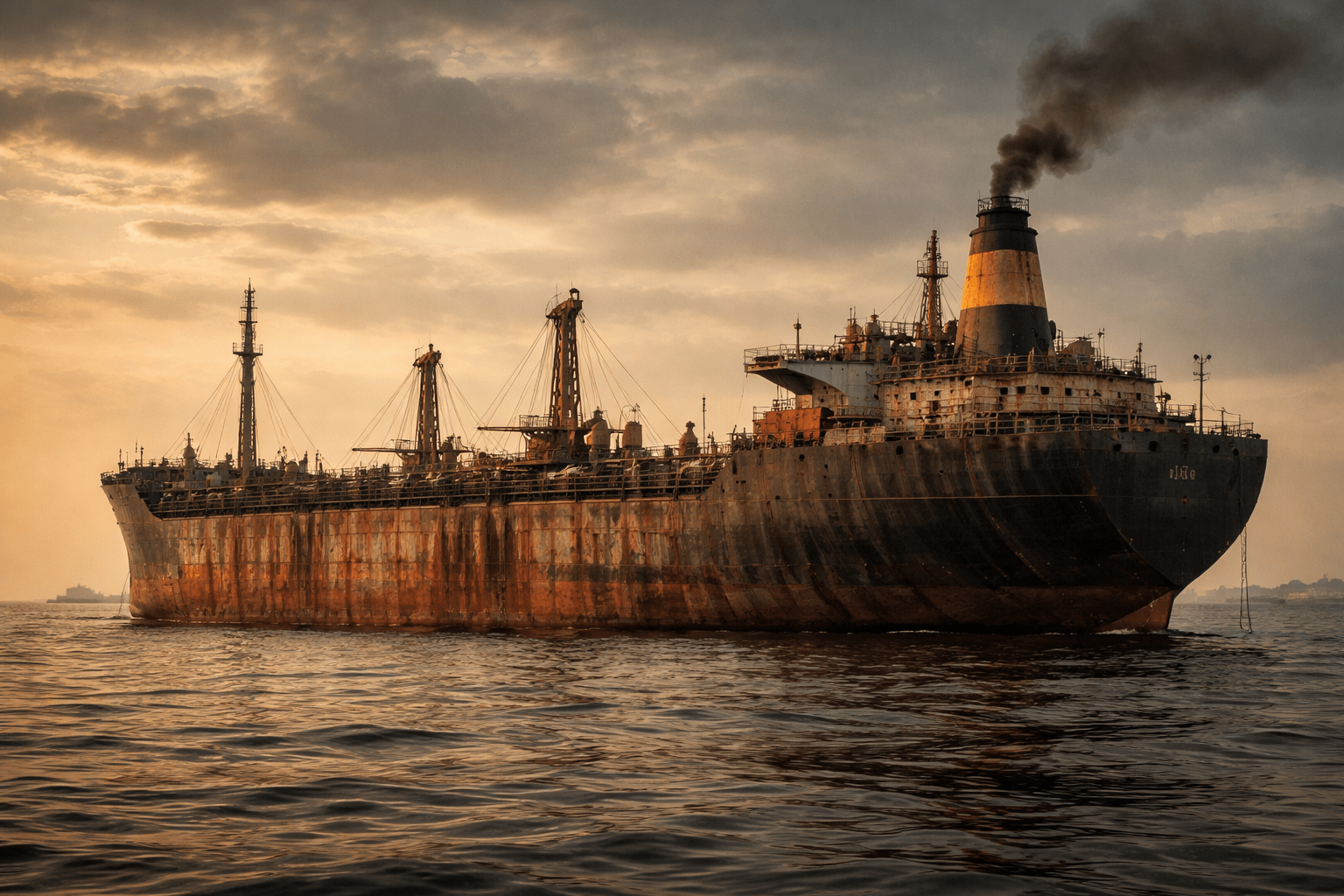
On a January morning in 2026, maritime traffic controllers in Copenhagen watched a radar blip drift off course in the Danish Straits. The vessel — a 22-year-old tanker carrying an estimated 100,000 tonnes of crude oil — had lost steering in near-zero visibility fog. For several tense hours, EU coast guard vessels shadowed it, hoping physics and luck would keep it off the rocks.
They did. This time.
What made the situation genuinely terrifying wasn’t the weather or the mechanical failure. It was the paperwork — or rather, the absence of it. The tanker was registered through a Russian shell company with no assets accessible to foreign courts. Its insurance certificate traced back to a domestic insurer in Moscow with capital reserves that maritime lawyers described, privately, as “essentially fictional.” Had that ship broken apart in the straits, spilling its cargo across Danish, Swedish, and German coastlines, the legal and financial mechanisms to pay for the cleanup simply did not exist.
This is the defining nightmare of what analysts now call the Ghost Fleet: not just that these ships sail without oversight, but that when the inevitable disaster happens, there will be no one to hold accountable and no money to pay the bill.
Why Old Ships Are Fundamentally Different
To understand why age matters so much in this context, it helps to understand what actually happens to a steel ship over two decades of saltwater exposure.
Hull fatigue is cumulative and non-linear. A tanker hull experiences thousands of stress cycles every year — flexing as waves pass beneath it, expanding and contracting with temperature changes, vibrating from its own engines. Metallurgical studies of decommissioned vessels show that crack propagation in hull steel accelerates sharply after the 15-year mark, particularly in welds and plate joints. This isn’t a gradual decline; it’s closer to a structural cliff.
Corrosion compounds the problem. Tankers carry ballast water that cycles through dedicated tanks, creating chronic wet-dry cycles in structural spaces. Without rigorous coating maintenance — the kind that requires dry-dock access every few years — these spaces corrode at rates that can reduce structural steel thickness by 20–30% within a decade. On a ship carrying a hundred thousand tonnes of crude oil, that means the only thing between the cargo and the ocean is steel that may be a fraction of its rated thickness.
The industry’s standard response to this risk is mandatory retirement. Under normal classification society rules (Lloyd’s, DNV, Bureau Veritas), tankers over 20 years face increasingly costly and demanding surveys. Over 25, insurance becomes prohibitively expensive, and the economics of scrapping overtake the economics of operation. This system works — when it applies.
For the Ghost Fleet, it doesn’t apply. These ships have been deregistered from major flag states, stripped of classification society certificates, and handed to operators who have no intention of presenting them for inspection. The 15-year and 20-year thresholds aren’t cliffs they fall off — they’re fences they duck under.
Current estimates from maritime intelligence firms including Windward and Lloyd’s List Intelligence place the average age of sanctioned-fleet tankers at 17–19 years, with a significant portion exceeding 22 years. For context: in the legitimate tanker market, a 22-year-old VLCC is typically months away from the breaker’s yard, not the loading terminal.
The Maintenance Improvisation Problem
Here’s what actually happens to a ghost tanker when something breaks at sea, far from any port willing to service it.
The crew — often underpaid and undertrained, recruited through labor intermediaries that shield the vessel’s real operators — works with whatever materials are available onboard. Weld repairs are made with substandard rods to plates that should be replaced entirely. Pump seals are substituted with improvised gaskets. Cargo heating systems, critical for keeping viscous crude oil flowing in cold water, are jury-rigged when components fail.
Experienced marine engineers describe this as “maintenance debt compounding.” Each improvised repair solves an immediate problem while creating three latent ones. A welded patch on a corroded hull plate changes the stress distribution around it, accelerating fatigue in adjacent areas. A leaking stern tube seal, tolerated because the ship can’t access a dry dock, slowly contaminates bilge water with oil. Over months and years, the accumulated improvisation transforms a vessel that was merely aging into one that is structurally unpredictable — a ship that can fail in ways that even experienced crews can’t anticipate.
What makes this particularly dangerous for oil spills specifically is the nature of tanker construction. Modern double-hull tankers have a buffer between cargo tanks and the ocean. Many ghost fleet vessels are single-hull designs, or older double-hulls with compromised inner surfaces. When they fail, they fail catastrophically.
The Insurance Architecture That Doesn’t Work
To understand why ghost fleet insurance is functionally worthless, you need to understand how real maritime insurance works.
The Protection and Indemnity (P&I) system is one of the most sophisticated mutual insurance structures in the world. The International Group of P&I Clubs — 13 major clubs covering roughly 90% of ocean-going tonnage — operates on a pooling principle where individual claims are shared across the membership. For major oil spills, the pool can draw on reinsurance coverage up to approximately $3.1 billion per incident. This is why the Prestige spill off Spain in 2002 and the Erika spill off France in 1999 resulted in (eventually) funded cleanup operations, even when initial liability was contested.
The system also has a verification function: P&I clubs conduct their own surveys and can refuse or cancel coverage for vessels that don’t meet standards. This creates a second layer of inspection beyond flag state oversight. Ships that can’t get P&I coverage can’t legally call at ports in most major jurisdictions — the 1992 Civil Liability Convention requires proof of insurance for vessels carrying more than 2,000 tonnes of oil as cargo.
Ghost fleet operators have built a parallel structure designed to look like this system while providing none of its substance.
Russian and Iranian state-backed insurers offer certificates that appear, superficially, to satisfy international requirements. But these certificates have several critical defects:
Capitalization gaps. The reinsurance backing for these policies, where it exists at all, typically runs to tens of millions of dollars — not billions. For a major spill, this is the difference between a functional cleanup fund and a rounding error.
Sovereign immunity shields. When the insuring entity is a state-backed institution, claimants face the near-impossible task of piercing sovereign immunity in foreign courts. Even if a court awards damages, collection against state assets is extraordinarily difficult.
Shell company opacity. The vessel ownership chain typically runs through three to five shell companies across multiple jurisdictions. By the time a spill response team has identified the responsible party, the assets have been restructured into inaccessibility.
Jurisdictional arbitrage. Many ghost tanker certificates are issued under flag states (Palau, Cameroon, Gabon have all been implicated) that lack the regulatory infrastructure to verify the underlying insurance. The certificate is real; the coverage is not.
Maritime lawyers who work on spill litigation describe this as “insurance theater” — a performance designed to satisfy formal requirements while ensuring that, in practice, no money flows to victims.
Ship-to-Ship Transfers: Where Risk Multiplies
One of the Ghost Fleet’s operational signatures is its reliance on ship-to-ship (STS) oil transfers to avoid port infrastructure and documentation requirements. Understanding why this matters requires some technical context.
An STS transfer involves two vessels lying alongside each other in open water, connected by flexible cargo hoses, while oil is pumped from one to the other. Under ideal conditions — calm seas, experienced crews, properly maintained equipment, and proper containment booms deployed around both vessels — this is a manageable operation. Major operators like STS Solutions and AFRAMAX STS Services have safety records that demonstrate this.
Ghost fleet STS operations happen under none of these conditions.
Transfers frequently occur in international waters chosen specifically for low surveillance coverage — areas off the coasts of West Africa, in the waters between Greece and Turkey, in the Persian Gulf outside territorial limits. Sea states are often marginal. Crews conducting these operations may have limited STS experience. Containment equipment is frequently absent or improvised. Critically, the operations often occur at night to minimize satellite detection.
When cargo hoses fail under these conditions — and they do fail, because ghost fleet hoses are often significantly past their rated service life — oil enters the water with no containment boom to limit spread. The immediate spill may be modest: a few hundred barrels. But in ecologically sensitive areas, even small chronic spills accumulate into significant damage. Fisheries degrade. Coastlines absorb contamination. Local communities bear the cost.
The larger danger is catastrophic failure: a hose rupture that triggers a cargo tank pressurization event, or a collision between the two vessels during the transfer. Maritime accident databases document several near-misses of this type involving suspected ghost fleet vessels in recent years. The full picture is obscured because ghost fleet operators have every incentive not to report incidents.
What a Major Spill Would Actually Cost
It is worth being concrete about the scale of liability that currently has no coverage.
The Deepwater Horizon disaster cost BP and its partners approximately $65 billion in total, including cleanup, fines, and settlement payments. The Prestige spill off Galicia cost an estimated €4.5 billion in total economic impact. The Erika spill in the Bay of Biscay generated damages claims exceeding €400 million.
These were cases where responsible parties were identifiable and solvent (or where the P&I system functioned). For a major ghost fleet spill in European waters — the scenario that Danish authorities nearly faced in January 2026 — the picture is fundamentally different.
Cleanup costs for a 100,000-tonne crude spill in a sensitive coastal area would realistically run to €1–3 billion, depending on geography, weather, and response speed. Economic damages to fishing industries, tourism, and coastal property could multiply that figure several times. In the Baltic Sea, whose limited water circulation makes recovery from oil contamination unusually slow, the long-term ecological and economic impact could persist for decades.
Against this, ghost fleet operators have structured their affairs to present essentially zero collectible assets to foreign courts. The gap between liability and coverage is not a rounding error. It is the entire liability.
This means cleanup costs, in the event of a major ghost fleet spill, would fall on the states bordering the affected coastlines — and ultimately on their taxpayers. The Ghost Fleet has effectively privatized oil revenue while socializing catastrophic environmental risk.
The Regulatory Gap and Why It Persists
The logical question is why the international community hasn’t closed this gap. The answer involves a combination of jurisdictional fragmentation, geopolitical paralysis, and the structural difficulty of regulating ships that have deliberately placed themselves outside normal oversight frameworks.
The International Maritime Organization (IMO) sets global shipping standards, but it operates by consensus among member states — including Russia and Iran, who have obvious interests in maintaining the current situation. Amendments to conventions like MARPOL and SOLAS move slowly even when there’s political will, which there isn’t here.
Flag state enforcement is the primary mechanism for maintaining standards, but ghost fleet operators specifically choose flag states with weak enforcement capacity or, in some cases, apparent willingness to overlook irregularities in exchange for registration fees. Attempting to regulate a Palau-flagged, Russian-owned, Iranian-chartered vessel carrying oil to a Chinese refinery is an exercise in jurisdictional whack-a-mole.
Port state control — the inspection of foreign vessels when they call at port — is the backstop, but ghost fleet vessels specifically avoid ports with rigorous PSC regimes (Paris MOU, Tokyo MOU). They transfer cargo at sea and call at ports with limited inspection capacity.
The EU has moved most aggressively, extending sanctions to specific vessels and threatening ports in third countries that service them. But the EU’s geographic reach is limited, and sanctioned vessels have demonstrated considerable creativity in circumventing geographic restrictions.
The Probability Question
Maritime risk analysts have begun modeling the probability of a major ghost fleet environmental incident, and the numbers are uncomfortable.
A vessel with the structural profile of a typical ghost fleet tanker — 20+ years old, last inspected years ago, operating in marginal sea states — has an annual probability of serious structural failure that maritime engineers estimate at several times the rate of a well-maintained, inspected vessel. Apply that probability across a fleet of several hundred vessels, operating year-round, and the question stops being “if” and starts being “when.”
The Ghost Fleet has been operating at significant scale since roughly 2022, when sanctions following the invasion of Ukraine drove a substantial portion of Russian oil exports out of legitimate shipping and into shadow logistics. We are now several years into an uncontrolled experiment in large-scale unregulated tanker operations. The fact that a Deepwater Horizon-scale event hasn’t happened yet is a function of probability, not safety.
Every near-miss — the Danish Straits incident, a reported anchor dragging incident off Singapore in late 2025, a suspected cargo leak off the Omani coast — is a data point in a distribution that will eventually produce a catastrophic outcome.
What Would Change Things
There are interventions that maritime policy experts argue could meaningfully reduce the risk, even within the constraints of international law.
Mandatory financial liability bonds for vessels transiting sensitive maritime corridors, required by coastal states as a condition of innocent passage — a legally contested but potentially viable approach.
Satellite-based behavioral screening that flags vessels exhibiting ghost fleet operational signatures (AIS manipulation, STS loitering, sanctioned port calls) for enhanced scrutiny.
Third-party consequences that make it economically costly for refineries, traders, and ports in non-sanctioning countries to handle ghost fleet cargo — effectively extending the sanctions perimeter through commercial rather than legal pressure.
International spill liability funds that don’t require identification of a responsible party, funded by levies on conventional shipping, to ensure that coastal communities aren’t left without recourse.
None of these are simple. All require political will that is currently in short supply. But the alternative — waiting for the mathematics of probability to produce its inevitable result — carries costs that will dwarf any prevention investment.
Conclusion: The Actuarial Certainty
Insurance companies have a word for situations where a loss is not uncertain but merely a matter of timing: actuarial certainty. The Ghost Fleet now represents an actuarial certainty of environmental disaster. The vessels are old enough, numerous enough, and poorly maintained enough that a major spill is not a scenario to be prevented but a timeline to be shortened or extended.
What makes this situation genuinely novel is the combination of scale and unaccountability. Previous maritime disasters — the Torrey Canyon, the Amoco Cadiz, the Exxon Valdez — were terrible, but they involved identifiable parties with reachable assets. The Ghost Fleet has been specifically engineered to ensure that when disaster comes, there is no one to hold responsible and nowhere to send the bill.
The ocean doesn’t care about shell companies. The oil doesn’t wait for courts to establish jurisdiction. The cost lands where the oil lands — on coastlines, fisheries, and communities that made no decision to accept this risk and have no mechanism to refuse it.
That is the shadow risk the world is currently pretending doesn’t exist.